14 Complete Car Services List: Essential Automotive Services Every Car Owner Should Know

Owning a car comes with several responsibilities beyond driving and refueling. Regular servicing is essential for keeping the engine healthy, maintaining road safety, improving performance, and preventing unexpected mechanical problems. From routine oil changes to complex transmission repairs, every vehicle requires different types of automotive services throughout its lifetime.
However, many car owners are unfamiliar with the complete range of services offered by automotive repair shops. Understanding these services makes it easier to identify what your vehicle needs, communicate with mechanics, and avoid paying for unnecessary repairs.
Whether you own a sedan, SUV, hatchback, pickup truck, or luxury vehicle, knowing the available maintenance and repair options can help you make informed decisions.
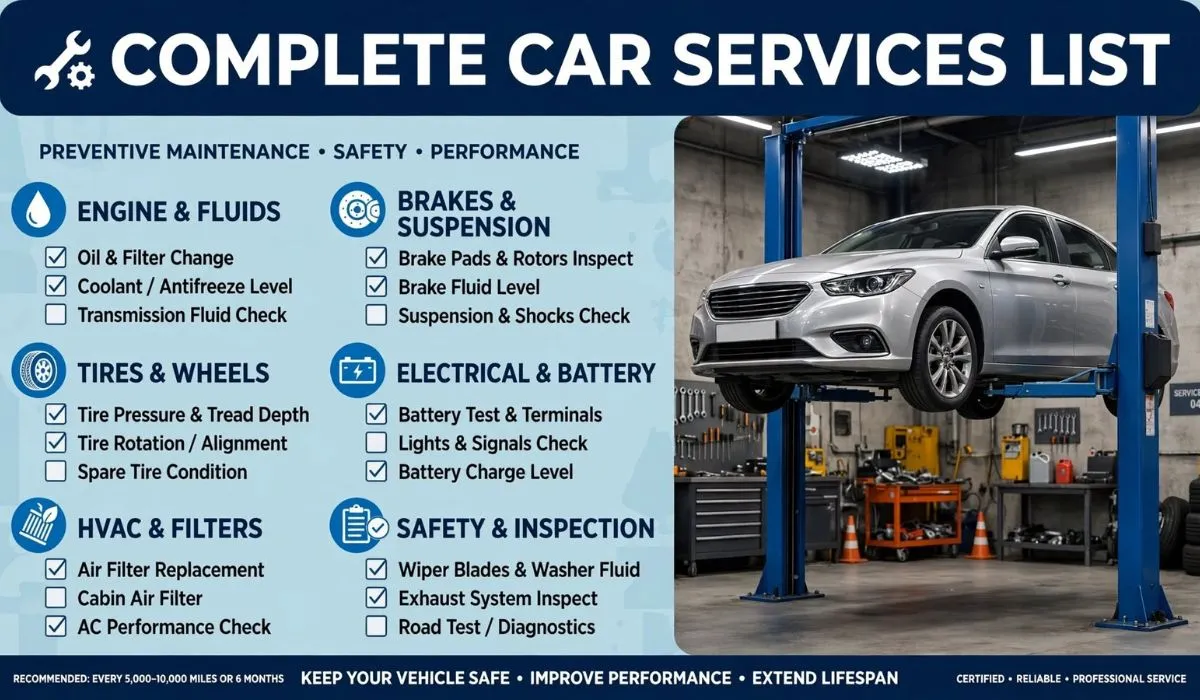
This complete car services list covers essential automotive services, including engine maintenance, brake repairs, tire services, electrical diagnostics, air conditioning, detailing, and preventive maintenance.
14 Complete Car Services List: Essential Automotive Services Every Car Owner Should Know:
1. Engine Maintenance and Repair Services
The engine is the heart of a vehicle. It converts fuel or other energy sources into the power needed to move the car. Regular engine servicing helps maintain performance, reduce unnecessary wear, and identify mechanical problems early.
Common Engine Services
- Engine oil change: Removes old engine oil and replaces it with fresh oil that meets manufacturer specifications.
- Oil filter replacement: Removes accumulated contaminants from the engine lubrication system.
- Air filter replacement: Helps maintain proper airflow into the engine.
- Spark plug replacement: Restores reliable ignition performance in gasoline engines.
- Fuel injector cleaning: Helps remove deposits that may affect fuel delivery and spray patterns.
- Timing belt replacement: Replaces a critical component according to the manufacturer’s service interval.
- Engine diagnostics: Uses diagnostic equipment to identify stored fault codes and potential engine problems.
- Engine tune-up: Involves inspecting and servicing relevant ignition, fuel, and engine management components.
When Does Your Engine Need Servicing?
Watch for warning signs such as unusual knocking sounds, excessive exhaust smoke, rough idling, reduced power, difficult starting, and unexpected increases in fuel consumption.
A check engine warning light may also indicate an issue that requires diagnostic testing.
2. Brake System Services
Brakes are among the most important safety components in a vehicle. A properly functioning braking system helps drivers control speed and stop safely in different road conditions.
Brake servicing involves inspecting hydraulic components, friction materials, and mechanical parts.
Popular Brake Services
- Brake pad replacement: Replaces worn friction materials used to slow the vehicle.
- Brake rotor resurfacing: Restores suitable rotor surface condition when permitted by manufacturer specifications.
- Brake rotor replacement: Replaces damaged or excessively worn rotors.
- Brake fluid replacement: Replaces aging brake fluid according to the manufacturer’s recommended interval.
- Brake caliper repair: Addresses sticking, leaking, or malfunctioning calipers.
- Brake line inspection: Checks hydraulic lines for corrosion, leaks, and physical damage.
- ABS diagnostics: Investigates problems with the anti-lock braking system.
- Parking brake adjustment: Corrects issues with the mechanical or electronic parking brake system.
Signs Your Brakes Need Attention
Grinding noises, squealing, unusual pedal movement, vibrations, brake warning lights, and longer stopping distances should never be ignored.
If braking performance is significantly reduced, stop driving and arrange professional assistance.
3. Tire and Wheel Services
Tires directly influence road grip, handling, braking, and driving comfort. Regular tire maintenance also helps prevent uneven wear and unexpected tire failures.
Essential Tire Services
- Tire rotation: Changes tire positions according to the vehicle manufacturer’s recommended pattern.
- Wheel balancing: Corrects uneven weight distribution to reduce vibration.
- Wheel alignment: Adjusts wheel angles to manufacturer specifications.
- Tire replacement: Installs new tires when existing ones are worn or damaged.
- Puncture repair: Repairs eligible tire punctures using approved methods.
- Tire pressure inspection: Checks inflation against the recommended pressure.
- Tread depth inspection: Measures remaining tread to assess tire condition.
- TPMS service: Inspects and services the tire pressure monitoring system.
Why Is Wheel Alignment Important?
Incorrect wheel alignment can contribute to uneven tire wear, steering problems, and poor vehicle handling.
If your vehicle pulls to one side or the steering wheel is off-center while driving straight, consider having the alignment inspected.
4. Transmission Services
The transmission transfers engine power to the wheels and helps the vehicle operate at different speeds. Depending on the vehicle, it may use a manual, automatic, continuously variable, or dual-clutch transmission.
Transmission servicing is important because fluid condition and component wear can affect shifting performance.
Common Transmission Services
- Transmission fluid replacement: Replaces transmission fluid according to manufacturer specifications.
- Transmission filter replacement: Replaces a serviceable filter where applicable.
- Transmission diagnostics: Identifies electronic and mechanical transmission faults.
- Clutch replacement: Replaces worn clutch components in applicable vehicles.
- Clutch adjustment: Adjusts compatible clutch systems according to manufacturer procedures.
- Transmission leak repair: Addresses leaking seals, gaskets, or connections.
- Transmission rebuild: Repairs internal components when a complete replacement is unnecessary.
- Transmission replacement: Installs another compatible transmission when repairs are not practical.
Symptoms of Transmission Problems
Difficulty shifting gears, slipping, delayed engagement, unusual noises, fluid leaks, and warning lights may indicate transmission problems.
Some modern transmissions have specific fluid service requirements, while others have sealed designs. Always follow the manufacturer’s instructions.
5. Battery and Electrical System Services
Modern vehicles depend on electrical systems for starting, lighting, engine management, infotainment, and safety features.
A weak battery or electrical fault can affect several vehicle functions simultaneously.
Common Electrical Services
- Battery testing: Checks battery condition and starting capacity.
- Battery replacement: Installs a compatible replacement battery.
- Alternator repair: Addresses charging system problems.
- Starter motor replacement: Replaces a faulty component responsible for engine cranking.
- Battery terminal cleaning: Removes corrosion and improves electrical connections.
- Fuse replacement: Replaces defective fuses with correctly rated components.
- Wiring inspection: Identifies damaged wires, loose connections, or electrical shorts.
- Lighting repair: Fixes malfunctioning headlights, taillights, and indicators.
- OBD-II diagnostics: Reads compatible vehicle diagnostic trouble codes.
When Should You Check the Electrical System?
A vehicle that struggles to start, produces dim headlights, displays battery warnings, or experiences intermittent electrical problems may require an electrical inspection.
Read next: 5 Best Car Maintenance Apps: Top Tools to Manage Vehicle Care and Repairs
6. Car Air Conditioning and Heating Services
A properly functioning climate control system improves cabin comfort and helps maintain visibility by assisting with windshield defogging.
Automotive air conditioning systems contain compressors, condensers, evaporators, refrigerant, and other components.
Air Conditioning Services
- AC inspection: Checks overall cooling system operation.
- Refrigerant leak detection: Identifies leaks in the AC system.
- Refrigerant recovery and recharge: Services refrigerant using appropriate equipment and procedures.
- AC compressor repair: Addresses compressor-related problems.
- Condenser replacement: Replaces a damaged or leaking condenser.
- Cabin air filter replacement: Helps maintain airflow and cabin air quality.
- Blower motor repair: Addresses airflow problems inside the cabin.
- AC evaporator cleaning: Removes accumulated contamination where appropriate.
- Heater system repair: Addresses problems with cabin heating.
Signs of AC Problems
Weak airflow, insufficient cooling, unusual odors, strange noises, and inconsistent temperature control may indicate that the system needs inspection.
Refrigerant servicing should be handled by trained technicians using suitable recovery and charging equipment.
7. Suspension and Steering Services
The suspension system helps absorb road impacts, maintain tire contact, and improve vehicle stability. Steering components allow drivers to control the direction of travel.
Damaged suspension or steering components can affect comfort and handling.
Common Suspension Services
- Shock absorber replacement.
- Strut replacement.
- Ball joint replacement.
- Control arm repair.
- Bushing replacement.
- Stabilizer bar link replacement.
- Coil spring replacement.
- Steering rack repair.
- Power steering system inspection.
- Tie rod end replacement.
Common Warning Signs
Excessive bouncing, unusual clunking sounds, uneven tire wear, steering vibrations, and difficulty controlling the vehicle may indicate suspension or steering problems.
These components should be inspected promptly because their condition can directly affect vehicle stability and safety.
8. Cooling System Services
The cooling system prevents the engine from operating at excessively high temperatures. It circulates coolant through important engine components and releases heat through the radiator.
Cooling system maintenance is particularly important in hot climates and during heavy traffic.
Common Cooling System Services
- Radiator inspection and repair.
- Coolant replacement.
- Water pump replacement.
- Thermostat replacement.
- Radiator hose inspection.
- Cooling fan repair.
- Coolant leak detection.
- Radiator flushing when recommended.
- Expansion tank inspection.
Signs of Cooling System Problems
Watch for engine temperature warnings, coolant leaks, steam, repeated overheating, and unexplained coolant loss.
Never open a hot radiator or pressurized coolant reservoir. Allow the system to cool before inspection.
9. Car Inspection and Diagnostic Services
Vehicle inspections help identify mechanical and electronic problems before they become more expensive or dangerous.
Professional repair shops use diagnostic equipment, visual inspections, and specialized testing tools to evaluate vehicle condition.
Types of Automotive Inspections
- General vehicle inspection: Checks major mechanical and safety components.
- Pre-purchase inspection: Evaluates a used car before buying it.
- Pre-trip inspection: Checks important vehicle systems before a long journey.
- Engine diagnostics: Investigates engine-related fault codes.
- Emissions testing: Evaluates vehicle emissions where required by local regulations.
- Electrical diagnostics: Identifies electrical faults and system malfunctions.
- Safety inspection: Evaluates brakes, tires, lighting, steering, and other safety-related components.
A diagnostic scan can identify stored trouble codes, but a mechanic may need additional testing to determine the actual cause.
10. Car Cleaning, Washing, and Detailing Services
Automotive detailing focuses on cleaning, restoring, and protecting the vehicle’s interior and exterior.
Unlike a basic car wash, detailing generally involves more detailed cleaning procedures.
Exterior Car Care Services
- Hand car washing.
- Pressure washing.
- Wheel and tire cleaning.
- Paint decontamination.
- Clay bar treatment.
- Paint polishing.
- Scratch removal where possible.
- Wax application.
- Paint sealant application.
- Ceramic coating.
- Headlight restoration.
Interior Detailing Services
- Carpet and upholstery cleaning.
- Leather seat cleaning and conditioning.
- Dashboard cleaning.
- Floor mat washing.
- Interior vacuuming.
- Odor removal.
- Interior glass cleaning.
- Steam cleaning where suitable.
These services help maintain vehicle appearance and can make regular cleaning easier.
11. Exhaust System Services
The exhaust system carries combustion gases away from the engine and helps control emissions and noise.
A damaged exhaust system may affect vehicle performance, produce unusual sounds, or allow harmful gases to enter areas where they should not.
Common Exhaust Services
- Exhaust pipe repair.
- Muffler replacement.
- Catalytic converter inspection.
- Exhaust manifold repair.
- Oxygen sensor replacement.
- Exhaust leak detection.
- Exhaust hanger replacement.
- Emissions system diagnostics.
A loud exhaust, unusual fumes, or a strong exhaust smell inside the cabin requires prompt professional inspection.
12. Fuel System Services
The fuel system stores, filters, and delivers fuel to the engine at the required pressure.
Problems in this system can cause difficult starting, poor acceleration, rough idling, and reduced engine performance.
Popular Fuel System Services
- Fuel filter replacement.
- Fuel injector inspection.
- Fuel injector cleaning where appropriate.
- Fuel pump replacement.
- Fuel pressure testing.
- Fuel line inspection.
- Fuel tank inspection.
- Throttle body cleaning where recommended.
Using the correct fuel and following manufacturer maintenance recommendations can help maintain fuel system performance.
13. Bodywork, Glass, and Collision Repair
Accidents, road debris, and everyday driving can cause damage to vehicle body panels, windows, mirrors, and exterior components.
Automotive body repair services help restore appearance and, where necessary, structural integrity.
Common Body and Glass Services
- Dent removal.
- Scratch repair.
- Panel replacement.
- Automotive repainting.
- Bumper repair.
- Windshield replacement.
- Windshield chip repair.
- Side window replacement.
- Mirror replacement.
- Collision damage assessment.
- Rust treatment and repair.
Structural damage should be evaluated by a qualified repair facility. Cosmetic repairs alone cannot correct damage to important structural components.
14. Additional Automotive Services
Some repair facilities offer specialized services beyond routine mechanical maintenance.
| Service | Purpose |
|---|---|
| Windshield wiper replacement | Restores effective windshield cleaning |
| Key programming | Programs compatible electronic vehicle keys |
| Remote key repair | Repairs certain remote key problems |
| ADAS calibration | Calibrates supported driver-assistance sensors and cameras |
| Hybrid system inspection | Checks relevant hybrid vehicle components |
| EV battery diagnostics | Evaluates supported electric vehicle battery information |
| Software updates | Updates compatible vehicle control systems |
| Tire pressure sensor replacement | Replaces faulty TPMS sensors |
| Roadside assistance | Provides support during breakdowns |
| Pre-purchase inspection | Helps evaluate used vehicle condition |
Not every workshop offers these services, and some require manufacturer-specific equipment.
How Often Should You Service Your Car?
There is no single maintenance schedule that applies to every vehicle. Service intervals depend on the manufacturer’s recommendations, vehicle age, mileage, engine type, and operating conditions.
The following table provides a general planning guide.
| Service | General inspection or service timing |
|---|---|
| Engine oil | Manufacturer’s mileage or time interval |
| Tire pressure | Monthly |
| Brake inspection | At scheduled servicing or when symptoms appear |
| Battery condition | Periodically and before starting problems develop |
| Coolant | Check periodically; replace as specified |
| Air filters | Inspect according to service schedule |
| Wheel alignment | When symptoms or inspection indicate a need |
| Transmission fluid | Manufacturer’s specified interval |
| AC system | Inspect when performance changes |
| Wiper blades | Inspect regularly and replace when worn |
Always prioritize the vehicle owner’s manual over generic maintenance intervals.
How to Choose the Right Car Service Center?
Selecting a reliable repair shop is just as important as choosing the correct service.
Check Experience and Qualifications
Look for technicians who have experience with your vehicle’s manufacturer and type of engine or transmission.
Specialized vehicles, hybrids, and electric cars may require additional training.
Ask for a Written Estimate
Before approving major repairs, request a breakdown of labor, replacement parts, additional fees, and estimated completion time.
Verify Replacement Parts
Ask whether the workshop uses genuine, original-equipment-equivalent, or aftermarket parts. Make sure the parts are compatible with your vehicle.
Review Service Records and Warranty Terms
Keep copies of invoices and ask whether the repair comes with a parts or labor warranty.
A professional workshop should be able to explain the work performed and provide documentation.
Final Thoughts
Understanding the complete car services list makes vehicle ownership easier and more predictable. From engine oil changes and brake inspections to transmission repairs, electrical diagnostics, and professional detailing, every service has a specific purpose.
The most effective approach is to follow your manufacturer’s maintenance schedule, pay attention to unusual vehicle behavior, and choose qualified technicians for repairs.
Not every car needs every service at the same time. Regular inspections and timely maintenance help you prioritize essential work, control ownership costs, and keep your vehicle operating safely.
Frequently Asked Questions (FAQs)
1. What are the most common car services?
The most common automotive services include engine oil changes, oil filter replacement, tire rotation, brake inspections, battery testing, air filter replacement, wheel alignment, and general vehicle inspections.
2. What services should a car receive regularly?
Cars generally need regular inspections of engine oil, tires, brakes, coolant, lights, and battery condition. Replacement services should follow the manufacturer’s recommended maintenance schedule.
3. What is included in a full car service?
A full car service commonly includes engine oil and filter replacement, fluid checks, brake inspections, tire inspections, battery testing, lighting checks, and general mechanical inspections. The exact package varies between repair shops and vehicle manufacturers.
4. What is the difference between car maintenance and car repair?
Maintenance involves preventive activities such as oil changes, inspections, and filter replacements. Repairs involve fixing or replacing components that are damaged, worn, or malfunctioning.
5. How much does a full car service cost?
The price depends on the vehicle model, engine type, required replacement parts, labor charges, and location. A basic service is generally less expensive than a comprehensive service involving additional parts or repairs.
6. How often should I take my car to a service center?
Follow the mileage and time intervals specified in your owner’s manual. Many vehicles have service schedules based on mileage, elapsed time, or both. Severe driving conditions may require more frequent inspections.
7. Are tire rotation and wheel alignment the same service?
No. Tire rotation changes the position of tires on the vehicle, while wheel alignment adjusts wheel angles to manufacturer specifications. Both can help maintain proper tire wear, but they address different issues.
8. What does a car diagnostic service include?
A diagnostic service may include scanning electronic control modules, retrieving trouble codes, checking sensor information, and performing additional tests to identify mechanical or electrical problems.
9. Which car services are most important for safety?
Brake inspections, tire maintenance, steering and suspension checks, lighting inspections, and windshield wiper maintenance are particularly important for safe driving.
10. Do electric cars need regular servicing?
Yes. Electric vehicles generally require less routine powertrain maintenance than conventional gasoline vehicles, but they still need tire inspections, brake servicing, cabin air filter replacement, coolant system checks where applicable, and high-voltage system inspections.
11. Can I perform basic car servicing at home?
Yes. Many owners can check tire pressure, inspect fluid levels, clean the vehicle, replace compatible wiper blades, and perform certain filter replacements. Complex repairs and safety-critical work should be handled by qualified technicians.
12. What should I check before approving a car repair?
Ask for the diagnostic findings, repair estimate, parts information, labor charges, warranty terms, and expected completion time. For expensive repairs, consider getting a second professional opinion.