When To Do Wheel Alignment | Best Time to Align Your Wheels

Knowing when to do wheel alignment can save you from premature tire wear, poor handling, steering problems, and unnecessary repair costs. Wheel alignment is not simply a routine service that every car needs at a fixed mileage. In many cases, the right time to perform an alignment depends on your vehicle’s symptoms, tire condition, road impacts, and maintenance history.
A vehicle with incorrect wheel alignment may still drive normally at first, which makes the problem easy to overlook. Over time, however, incorrect wheel angles can cause uneven tread wear and affect how the vehicle tracks on the road.
What Is Wheel Alignment?
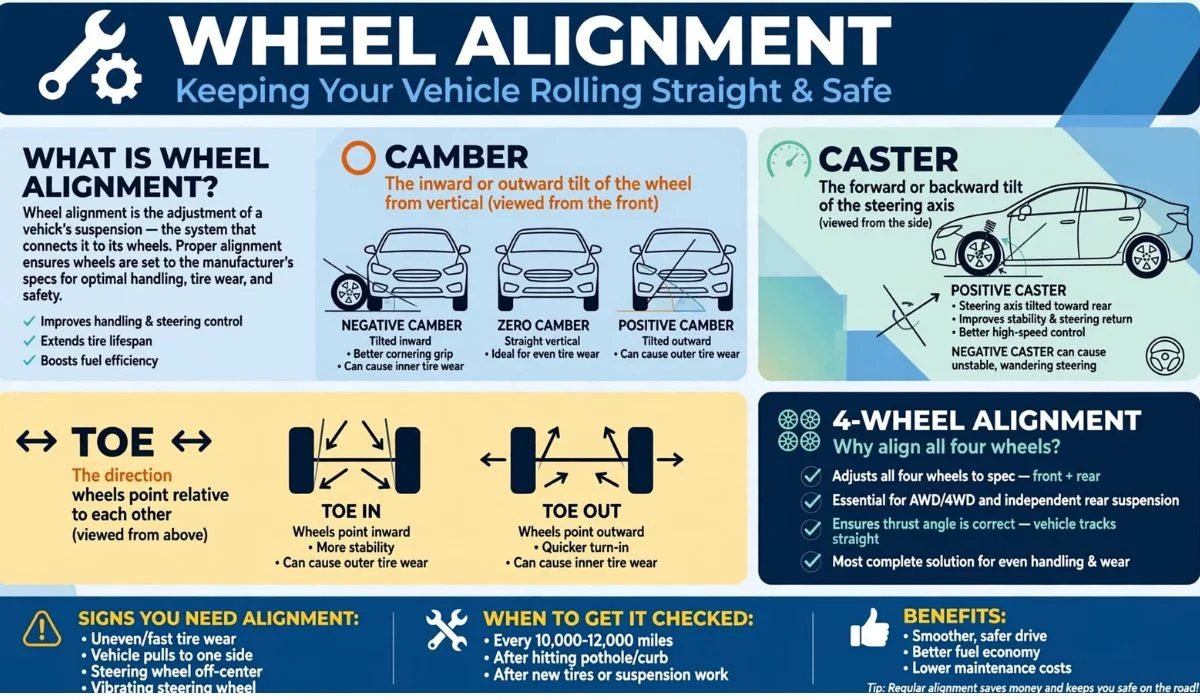
Wheel alignment is the process of measuring and, when possible, adjusting the angles of the vehicle’s wheels according to the manufacturer’s specifications.
The main alignment angles are generally toe, camber, and caster, although the exact adjustment possibilities vary by vehicle.
Toe
Toe describes the direction the wheels point relative to the vehicle’s centerline when viewed from above.
Incorrect toe can contribute to feathering and accelerated tire wear.
Camber
Camber describes how much the top of a wheel tilts inward or outward when viewed from the front.
The correct amount varies according to the vehicle’s design.
Caster
Caster describes the angle of the steering axis when viewed from the side of the vehicle.
It can influence steering stability, steering feel, and the steering wheel’s tendency to return toward center.
When Should You Do a Wheel Alignment?
There isn’t one universal answer for every vehicle.
You should consider an alignment when there is evidence that the wheel angles may have changed or when the manufacturer specifically recommends an inspection.
The following situations are among the most common reasons to have alignment checked.
Your car pulls to one side
If your vehicle consistently drifts or pulls left or right on a reasonably level road, alignment is one possible cause.
However, pulling does not automatically mean the alignment is incorrect.
Unequal tire pressure, tire characteristics, road slope, brake problems, steering components, and suspension issues can also cause the vehicle to pull.
Your steering wheel is off-center
If the vehicle travels relatively straight but the steering wheel sits noticeably to one side, an alignment inspection may be appropriate.
An off-center steering wheel can occur after suspension or steering work, a road impact, or an alignment issue.
Your tires are wearing unevenly
Inspect the tread across the entire width of each tire.
Signs such as excessive wear on one edge or irregular tread patterns can indicate an alignment problem.
Incorrect tire pressure and worn suspension components can produce similar symptoms, so the entire system should be evaluated.
When to Do Wheel Alignment After Hitting a Pothole:
A major pothole can deliver a strong impact to the tire, wheel, suspension, and steering system.
You don’t necessarily need an alignment after every small pothole, but a significant impact deserves attention if the vehicle’s behavior changes.
Watch for these symptoms afterward
Check the vehicle if you notice:
- Steering wheel suddenly becomes crooked
- Vehicle begins pulling
- New vibration appears
- Tire loses air
- Wheel appears damaged
- Handling feels different
- New or unusual tire noise develops
A pothole can cause more than an alignment problem, so a technician may need to inspect the tire, wheel, steering, and suspension.
When to Do Wheel Alignment After Hitting a Curb
A curb impact can affect wheel geometry, especially when the impact is significant.
If you hit a curb hard enough to produce a noticeable change in steering or handling, have the vehicle inspected.
Don’t ignore visible damage
Look for:
- Cracked or bent wheel
- Tire bulge
- Cut sidewall
- Loss of tire pressure
- Crooked steering wheel
- New vibration
If a wheel or suspension component is damaged, an alignment alone may not solve the problem.
Should You Get an Alignment After New Tires?
Not automatically.
Installing new tires does not necessarily mean the vehicle needs an alignment.
However, an alignment inspection can be useful when the old tires had abnormal wear or when the vehicle already showed steering symptoms.
New tires and alignment serve different purposes
When new tires are mounted, the tire-and-wheel assemblies normally need balancing.
Alignment, meanwhile, concerns the geometry of the vehicle’s wheels.
A tire shop may recommend checking alignment during new-tire installation if there are signs of uneven wear or steering problems.
Should You Get an Alignment After Tire Rotation?
A tire rotation by itself does not normally require a wheel alignment.
Rotation changes tire positions according to the recommended rotation pattern.
Use rotation as an inspection opportunity
During tire rotation, look for:
- Uneven tread wear
- Feathering
- Shoulder wear
- Different wear rates
- Tire damage
- Abnormal tread patterns
If these conditions appear, an alignment inspection may be appropriate.
When to Do Alignment After Suspension Repairs
Some steering and suspension repairs can alter wheel geometry.
For example, replacing certain steering or suspension components may require the vehicle to be realigned afterward.
Ask after replacing major components
Depending on the vehicle and repair, alignment may be appropriate after work involving:
- Tie rods
- Control arms
- Ball joints
- Steering components
- Certain bushings
- Other adjustable suspension components
The exact requirement depends on the vehicle design and the component replaced.
How Often Should You Get a Wheel Alignment?
There is no single mileage interval that applies to every vehicle.
Some manufacturers provide alignment inspection recommendations, while others focus on checking alignment when symptoms or abnormal tire wear appear.
Your driving environment also matters.
Driving conditions affect alignment
Frequent driving over potholes, damaged roads, curbs, and rough surfaces can increase the likelihood of impacts affecting wheels or suspension.
Drivers who regularly travel on poor roads should pay closer attention to tire wear and steering behavior.
Do You Need Wheel Alignment Every Year?
Not necessarily.
If your vehicle drives normally, the steering wheel remains centered, and the tires are wearing evenly, an annual alignment may not be necessary unless your manufacturer recommends it.
An inspection can still be useful if you notice a change in handling or tire condition.
Read Next: Firestone Lifetime Alignment Terms | Eligibility, and Service Requirements
Do You Need Alignment Every 10,000 Miles?
Not automatically.
A mileage-based rule such as every 10,000 miles may be appropriate for some maintenance schedules, but it is not a universal requirement for every vehicle.
Always check your owner’s manual first.
Don’t confuse inspection with adjustment
A technician can inspect alignment angles without necessarily needing to make an adjustment.
If measurements are within the manufacturer’s specified range and there are no other problems, additional adjustment may not be necessary.
Signs You Should Get an Alignment Soon
Some symptoms deserve more attention than others.
Uneven tire wear is an important warning
Check the inside, center, and outside portions of your tire tread.
If one edge is wearing substantially faster than the rest, don’t simply replace the tire without investigating the cause.
Alignment may be involved, but incorrect tire pressure, suspension wear, wheel problems, or tire rotation issues can also contribute.
The vehicle suddenly handles differently
A sudden change in steering response should be investigated.
This is particularly important when the change occurs immediately after hitting a pothole, curb, or other road obstacle.
Can Bad Alignment Cause Tire Wear?
Yes.
Incorrect alignment can cause certain parts of the tread to contact the road differently than intended.
This may produce:
- One-sided wear
- Feathering
- Uneven shoulder wear
- Accelerated tread loss
Alignment cannot restore worn tread
Correcting the alignment can help prevent additional abnormal wear, but it cannot restore rubber that has already been worn away.
If a tire is severely worn, replacement may be necessary even after the alignment problem is corrected.
Can Bad Alignment Affect Fuel Economy?
It can potentially contribute to increased rolling resistance when the wheels are not positioned correctly, but alignment is only one factor affecting fuel consumption.
Tire pressure, tire type, vehicle load, driving style, engine condition, and road conditions can have substantial effects on fuel economy.
Alignment should therefore be maintained for proper vehicle operation rather than viewed as a guaranteed fuel-saving service.
Can Bad Alignment Cause Steering Problems?
Incorrect alignment can affect steering behavior.
You may notice:
- Vehicle pulling
- Off-center steering wheel
- Uneven steering response
- Increased steering effort in certain situations
However, steering problems can also result from worn or damaged components.
Alignment is not a substitute for repairs
If a steering or suspension component is damaged or excessively worn, correcting wheel angles may not resolve the underlying problem.
The defective component should be diagnosed and repaired first.
Does Wheel Alignment Improve Handling?
Proper alignment helps the vehicle’s wheels operate according to the manufacturer’s intended geometry.
This can contribute to predictable steering and appropriate tire contact with the road.
However, alignment alone cannot compensate for worn tires, damaged suspension components, incorrect tire pressure, or other mechanical problems.
Wheel Alignment vs. Wheel Balancing
These services are frequently confused, but they solve different problems.
| Feature | Wheel Alignment | Wheel Balancing |
|---|---|---|
| Main purpose | Correct wheel geometry | Correct weight distribution |
| Common symptom | Pulling or uneven wear | Vibration |
| Main components involved | Steering and suspension geometry | Tire and wheel assembly |
| Common trigger | Pothole, curb, suspension work | New tire installation |
| Does it fix vibration? | Not necessarily | Yes, if imbalance is the cause |
| Does it correct pulling? | Potentially | Usually not |
How Long Does a Wheel Alignment Take?
The time required depends on the vehicle, the condition of the steering and suspension system, the type of alignment equipment, and whether adjustments are straightforward.
A simple alignment can often be completed within a typical service appointment, while a vehicle with damaged or seized components may require additional diagnostic or repair time.
Repairs can extend the appointment
If the technician discovers worn or damaged parts, those issues may need to be addressed before the alignment can be completed correctly.
What Happens During a Wheel Alignment?
A technician generally begins by inspecting relevant tires, steering, and suspension components.
The vehicle is then positioned on alignment equipment so the wheel angles can be measured.
Measurements are compared with specifications
The measured values are compared with the appropriate manufacturer specifications.
Where adjustments are available, the technician can make corrections and then verify the final measurements.
The exact procedure varies according to vehicle design and alignment equipment.
Can You Drive With Bad Wheel Alignment?
A vehicle with a minor alignment issue may remain driveable, but continuing to ignore significant symptoms is not a good maintenance strategy.
Incorrect alignment can contribute to tire wear and handling problems.
Know when to stop driving
If you experience severe steering problems, sudden pulling, a damaged tire, significant vibration, or other major changes after an impact, stop in a safe location and have the vehicle inspected.
Don’t assume the problem is simply alignment.
How to Prevent Alignment Problems
You cannot prevent every alignment issue, but good driving and maintenance habits can reduce unnecessary problems.
Protect your wheels and suspension
Try to:
- Avoid potholes when safely possible
- Approach curbs carefully
- Maintain recommended tire pressure
- Rotate tires according to the manufacturer’s schedule
- Inspect tires regularly
- Repair suspension problems promptly
- Avoid unnecessary impacts with road obstacles
Correct tire inflation is particularly important because underinflation and overinflation can also cause abnormal tire wear.
A Simple Alignment Decision Guide
You can use a few basic rules to determine when an inspection makes sense.
Car drives normally + tires wear evenly: Follow the manufacturer’s maintenance recommendations.
Vehicle pulls consistently: Check tire pressure and have the vehicle inspected.
Steering wheel becomes crooked: Schedule an alignment inspection.
Uneven tire wear appears: Investigate alignment, pressure, suspension, and tire condition.
Major pothole or curb impact: Inspect the tire, wheel, steering, suspension, and alignment if symptoms occur.
New steering or suspension components installed: Ask whether an alignment is required.
New tires installed: Balance the tire-and-wheel assemblies and consider alignment if there are symptoms or abnormal wear.
Should You Get an Alignment Before a Long Trip?
If the vehicle has no symptoms and the tires are wearing normally, a special alignment solely because you are taking a long trip is not necessarily required.
However, a pre-trip inspection becomes more valuable if you recently hit a pothole, noticed pulling, have an off-center steering wheel, or see abnormal tire wear.
Check the tires too
Before a long trip, inspect:
- Tire pressure
- Tread depth
- Sidewalls
- Spare tire or emergency tire equipment
- Visible wheel damage
Alignment is only one part of preparing a vehicle for extended driving.
Final Takeaway
The best answer to when to do wheel alignment is not simply “every X miles.”
Have your alignment checked when you notice persistent pulling, an off-center steering wheel, uneven tire wear, or changes in handling. It is also wise to consider an inspection after a significant pothole or curb impact and after certain steering or suspension repairs.
New tires do not automatically require an alignment, although they should normally be balanced when installed. Likewise, tire rotation does not automatically mean your vehicle needs an alignment.
Most importantly, don’t diagnose every steering or tire problem as alignment. Tire pressure, tire defects, wheel damage, brakes, steering components, and suspension parts can create similar symptoms.
Following the manufacturer’s specifications and responding quickly to changes in handling or tire wear is the most reliable approach to maintaining proper wheel alignment.
FAQs
When is the best time to get a wheel alignment?
The best time is when you notice pulling, an off-center steering wheel, uneven tire wear, or changes in handling. Alignment may also be appropriate after a significant pothole or curb impact or certain suspension repairs.
How often should I get a wheel alignment?
There is no universal interval for every vehicle. Follow the manufacturer’s maintenance recommendations and have the alignment checked when symptoms or abnormal tire wear appear.
Do I need an alignment every year?
Not necessarily. A vehicle that drives normally and has evenly wearing tires may not require an annual alignment unless the manufacturer recommends one.
Do new tires need an alignment?
New tires do not automatically require alignment. However, an alignment inspection can be useful if the old tires showed abnormal wear or the vehicle has steering symptoms.
Do new tires need balancing?
Yes. Tire-and-wheel assemblies should generally be balanced when new tires are mounted.
Should I get an alignment after hitting a pothole?
A severe pothole can affect alignment or damage tires, wheels, steering, or suspension components. If the vehicle behaves differently afterward, have it inspected.
Can a curb knock a car out of alignment?
Yes. A strong curb impact can potentially change wheel geometry or damage related components. An inspection is recommended if steering or handling changes.
Can bad alignment cause uneven tire wear?
Yes. Incorrect alignment can contribute to one-sided wear, feathering, and other irregular tread patterns. Tire pressure and suspension condition can cause similar wear.
Can bad alignment cause a car to pull?
Yes, incorrect alignment can contribute to pulling. However, tire pressure, tire characteristics, road slope, brake problems, and suspension issues can also cause pulling.
Can wheel alignment fix a shaking steering wheel?
Not always. Steering-wheel vibration may be caused by wheel imbalance, tire problems, bent wheels, suspension issues, or other mechanical faults.
Is wheel alignment the same as wheel balancing?
No. Alignment corrects wheel geometry, while balancing corrects uneven weight distribution in a tire-and-wheel assembly.
Does tire rotation affect wheel alignment?
Normal tire rotation does not change wheel alignment. However, rotating the tires provides a useful opportunity to inspect tread wear for signs of alignment problems.
Can I drive with bad wheel alignment?
You may be able to drive with a minor alignment problem, but significant pulling, abnormal tire wear, or handling changes should be investigated promptly to avoid additional problems.
Does alignment improve tire life?
Correct alignment can help prevent certain forms of abnormal tire wear. However, tire life also depends on pressure, rotation, tire construction, road conditions, load, and driving habits.
Does wheel alignment improve fuel economy?
Correct alignment can help maintain proper vehicle operation, but fuel economy depends on many factors. Tire pressure, vehicle condition, driving style, and road conditions can have significant effects.
Should I get an alignment after suspension work?
Certain steering and suspension repairs can affect wheel geometry, so an alignment may be required afterward. The exact requirement depends on the vehicle and components repaired.
What are the main signs of bad wheel alignment?
Common signs include pulling to one side, an off-center steering wheel, uneven tire wear, and changes in steering or handling. These symptoms can also have other causes, so proper diagnosis is important.