
Is Firestone Lifetime Alignment Worth It? Lifetime Plan Saves Money

If you are considering Firestone lifetime alignment, you may be wondering whether paying extra upfront actually saves money or whether it is simply an unnecessary tire-shop add-on.
For drivers who keep the same vehicle for several years, regularly drive on rough roads, replace tires frequently, or want alignment checks whenever necessary, a lifetime alignment plan can potentially be worthwhile. However, it is not automatically a good deal for everyone. The value depends on how long you keep your car, how often you need alignment service, the local price of individual alignments, and the specific terms offered by your Firestone location.
What Is Firestone Lifetime Alignment?
Firestone Complete Auto Care offers alignment services, and some locations offer lifetime alignment packages or related service plans. The basic idea behind a lifetime alignment plan is that, after paying the applicable upfront price, you can return for qualifying alignment services for as long as you own the vehicle, subject to the plan’s terms and conditions.
The important point is that “lifetime” does not mean unlimited free automotive repairs.
The plan is generally intended to cover qualifying wheel alignment service, not every problem involving steering, suspension, tires, or wheels.
What an alignment actually does
A wheel alignment adjusts or verifies the angles of the wheels relative to the vehicle and road.
Depending on the vehicle, technicians may measure angles such as:
- Toe
- Camber
- Caster
Not every angle is adjustable on every vehicle.
A proper alignment can help maintain appropriate handling and reduce certain types of irregular tire wear.
Is Firestone Lifetime Alignment Worth It?
It can be worth it if you plan to keep your vehicle for several years and expect to need multiple alignments.
It is less attractive if you are likely to sell the vehicle soon, rarely drive, drive primarily on smooth roads, or almost never need alignment corrections.
The calculation is fairly simple: compare the upfront lifetime-plan price with what you would otherwise spend on individual alignment services during the time you own the vehicle.
A simple break-even example
Suppose a hypothetical lifetime plan costs $220 and a conventional alignment costs $120.
After one alignment:
$220 lifetime plan vs. $120 individual service
The lifetime plan has not paid for itself yet.
After two qualifying alignments:
$220 lifetime plan vs. $240 individual services
At that point, the lifetime plan would have theoretically passed the break-even point, assuming the services and pricing are comparable.
Actual Firestone prices vary by location, vehicle, promotions, and service terms, so use your local quote rather than assuming these example prices are current.
The Biggest Advantage: Multiple Alignment Visits
The strongest argument for a lifetime alignment plan is simple: you can potentially use the service more than once.
Alignment can change over the life of a vehicle due to pothole impacts, curb strikes, suspension work, worn components, and other factors.
Rough roads make the plan more attractive
If you regularly drive on roads with potholes, broken pavement, speed bumps, or other severe road conditions, you may have more reason to check alignment periodically.
A vehicle that encounters repeated impacts can experience changes in wheel geometry or suspension condition.
For such drivers, the ability to return for qualifying alignment service can provide useful value.
How Long Do You Need to Keep Your Car?

Vehicle ownership duration is one of the most important factors in the calculation.
If you keep a car for only one or two years, a lifetime alignment package may not provide enough opportunities to recover its upfront cost.
If you keep the same vehicle for five, seven, or ten years, the potential value is considerably different.
Long-term owners have the advantage
Imagine two drivers:
Driver A: Keeps a vehicle for one year and never experiences alignment problems.
Driver B: Keeps the vehicle for eight years and needs several alignment checks.
The second driver has significantly more opportunity to benefit from a lifetime plan.
This is why the word “lifetime” can be misleading. It usually means the lifetime of your ownership of the covered vehicle, not your lifetime as a customer.
Does Lifetime Alignment Mean You Can Get an Alignment Anytime?
You should not assume that every visit is automatically free under every circumstance.
The exact terms of the plan matter.
Some service plans can have restrictions involving the covered vehicle, ownership, appointment requirements, eligibility, or services included.
Read the terms before purchasing
Before paying for a lifetime alignment package, ask the store:
- What exactly is included?
- Does the plan cover alignment checks as well as adjustments?
- Is there a limit on visits?
- Does the plan remain valid for as long as I own the vehicle?
- What happens if I sell the vehicle?
- Can I use it at other Firestone locations?
- Are damaged or modified suspension components excluded?
- Are replacement parts extra?
- Is there a warranty or service-plan expiration condition?
- Are there vehicle-specific exclusions?
Getting these answers in writing can prevent misunderstandings later.
What Lifetime Alignment Does Not Usually Fix:
One of the most important things to understand is that alignment is not the same thing as suspension repair.
If your car has a damaged or worn component, an alignment alone may not solve the problem.
Worn suspension parts can cause alignment problems
Potential issues can include:
- Worn tie-rod ends
- Damaged control arms
- Worn ball joints
- Bent suspension components
- Damaged wheels
- Worn wheel bearings
- Failed bushings
If a component is loose or damaged, the technician may need to repair it before a proper alignment can be completed.
The lifetime alignment plan should not be viewed as a substitute for those repairs.
What About Pothole Damage?
Potholes are one of the strongest arguments for keeping an alignment service available.
A severe impact can potentially damage a tire or wheel and may affect suspension or alignment.
However, the alignment service itself does not necessarily cover the cost of repairing physical damage.
Alignment after a major impact
If you hit a large pothole and notice:
- The steering wheel is suddenly crooked
- The vehicle pulls
- A tire loses pressure
- New vibration appears
- The vehicle handles differently
- A wheel looks bent
have the vehicle inspected.
Don’t simply assume that another alignment will fix everything.
Does Lifetime Alignment Save Money?

It can, but only if you actually use it enough.
The best way to evaluate the purchase is with a break-even calculation.
Use this basic formula:
Break-even number of alignments = Lifetime plan price ÷ individual alignment price
For example, if your plan costs $240 and an individual alignment costs $120:
$240 ÷ $120 = 2 alignments
So you would need roughly two comparable paid alignments to reach the basic price break-even point.
Remember the hidden variables
Your calculation should also consider:
- How long you will own the vehicle
- Current alignment prices
- Future alignment prices
- Whether the plan has restrictions
- Whether you actually need multiple alignments
- Travel distance to the service center
- Extra repairs that may be required
A theoretical break-even point does not guarantee actual savings.
Who Should Consider Firestone Lifetime Alignment?
A lifetime plan makes the most sense for certain types of drivers.
High-mileage drivers
If you drive many miles every year, your vehicle experiences more road exposure.
That can increase opportunities for pothole impacts, tire wear, suspension work, and alignment checks.
Long-term vehicle owners
Keeping the same car for many years gives you more time to potentially use the plan.
This is probably one of the strongest reasons to consider it.
Drivers with frequent alignment needs
If your vehicle frequently develops alignment issues despite having a properly maintained suspension, multiple visits can make a lifetime plan financially attractive.
Read Next: When To Do Wheel Alignment And Balancing
Who Probably Should Skip It?
Not everyone needs a lifetime plan.
People who change cars frequently
If you usually sell or trade your vehicle after a short ownership period, there may not be enough time to benefit.
Drivers who rarely need alignment
If your vehicle stays aligned for years and you do not encounter many road hazards, paying for individual service when necessary may be cheaper.
People who live far from the service center
A lifetime service has limited practical value if every visit requires a long drive.
Your time, fuel, and inconvenience are part of the real cost.
Does Buying New Tires Make Lifetime Alignment More Valuable?
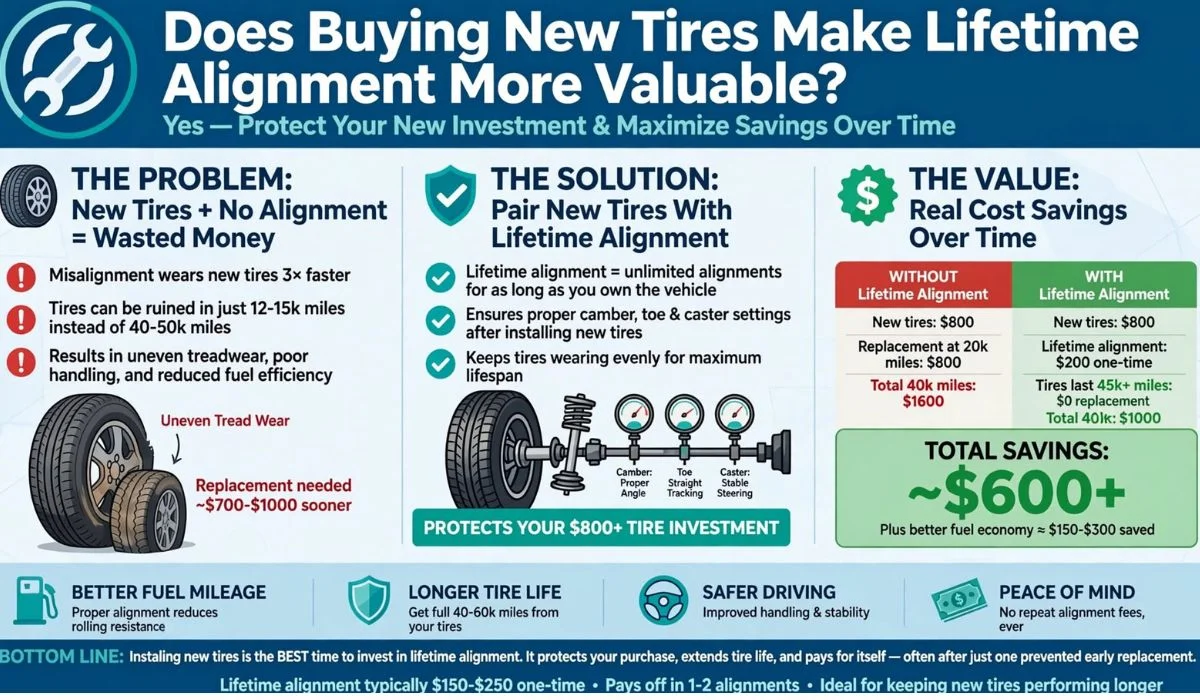
New tires represent a significant investment, and maintaining appropriate alignment can help protect them from certain forms of abnormal wear.
However, alignment should not be performed merely because tires are new.
Alignment is especially relevant when tire wear is abnormal
If your old tires showed:
- One-sided wear
- Excessive shoulder wear
- Feathering
- Irregular tread wear
then it is worth investigating the cause.
Improper alignment is one possibility, but tire pressure, suspension components, tire rotation, road conditions, and other factors can also contribute.
Should You Get an Alignment Every Time You Rotate Tires?
Not necessarily.
Tire rotation and wheel alignment are different maintenance services.
A tire rotation changes tire positions according to the vehicle manufacturer’s recommended pattern.
An alignment changes or verifies wheel geometry.
Inspect during rotation instead
A tire rotation is a convenient opportunity to look for abnormal tread wear.
If the tires look unusual or the vehicle has steering symptoms, an alignment inspection may be appropriate.
Automatically performing a full alignment at every rotation is not necessarily required for every vehicle.
Lifetime Alignment vs. Paying Each Time
| Factor | Lifetime Alignment | Pay Per Alignment |
|---|---|---|
| Upfront cost | Higher | Lower |
| Cost per future qualifying visit | Potentially lower | Pay each time |
| Best for | Long-term owners | Short-term owners |
| Multiple visits | Potential advantage | More expensive over time |
| Break-even | Depends on local prices | No break-even calculation |
| Flexibility | Depends on plan terms | Generally straightforward |
| Main risk | Paying upfront but rarely using it | Paying more if frequent alignments are needed |
How to Decide in Five Minutes
You don’t need complicated math.
Start with the price of the lifetime alignment package.
Then ask for the current price of a standard alignment for your exact vehicle.
Next, estimate how long you plan to keep the car.
Use this decision rule
Buy the lifetime plan if:
- You expect to keep the vehicle for years.
- The break-even point is reasonably low.
- You drive on rough roads frequently.
- You have experienced alignment problems before.
- The plan’s terms are convenient for you.
Consider paying individually if:
- You may sell the car soon.
- You drive relatively little.
- Your vehicle rarely needs alignment.
- The lifetime plan is substantially more expensive.
- The service location is inconvenient.
What Questions Should You Ask Firestone?
Before purchasing, don’t just ask, “Is it lifetime?”
Ask what lifetime means under the specific plan being sold to you.
Get the important details
Ask whether:
- The plan follows the vehicle or the original owner.
- There is a maximum number of visits.
- The service is transferable.
- Adjustments are included.
- Inspection-only visits are included.
- Replacement parts are separate.
- Bent wheels or damaged suspension are excluded.
- Modified vehicles are covered.
- The plan works at other locations.
- Appointments are required.
These details can significantly affect the real-world value.
Is Lifetime Alignment a Good Deal for an Older Car?
It can be, particularly if you intend to keep the vehicle for several more years.
Older vehicles may have more suspension and steering wear, though that does not mean an alignment itself will solve those problems.
Condition matters more than age
An older vehicle with a healthy suspension system can benefit from correct alignment just like a newer vehicle.
But if the suspension is worn, repairing the underlying issue comes first.
Can Lifetime Alignment Improve Tire Life?
Correct alignment can help prevent certain types of abnormal tire wear.
However, it cannot guarantee longer tire life.
Tire longevity also depends on:
- Tire pressure
- Rotation
- Driving style
- Road surfaces
- Vehicle weight
- Tire design
- Suspension condition
- Climate
- Wheel balance
Think of alignment as one piece of tire maintenance rather than a guarantee that your tires will last longer.
Does Wheel Balancing Come With Lifetime Alignment?
Do not assume that it does.
Alignment and balancing are separate services.
Alignment addresses wheel geometry, while balancing addresses the distribution of weight around the tire-and-wheel assembly.
If your car develops a vibration, the appropriate solution may involve balancing, tire inspection, wheel inspection, or another diagnosis rather than alignment.
What If the Car Pulls After an Alignment?
If the vehicle still pulls after an alignment, additional diagnosis may be necessary.
Possible causes include:
- Unequal tire pressure
- Tire construction differences
- Tire damage
- Road crown
- Brake drag
- Suspension problems
- Steering component issues
- Incorrect or incomplete alignment
A persistent pull should not automatically be blamed on the alignment service.
Final Verdict: Is Firestone Lifetime Alignment Worth It?
Firestone lifetime alignment can be worth it for a long-term vehicle owner who expects to need multiple alignment services.
The biggest advantage is the potential to spread the upfront cost across several qualifying alignment visits.
However, it is not automatically the best choice. If you rarely need alignments, plan to sell the car soon, or have to travel a long distance to use the service, paying for individual alignments may make more financial sense.
The smartest approach is to calculate your local break-even point and carefully read the plan’s terms before purchasing.
If the plan costs only modestly more than one or two individual alignments and you expect to keep the vehicle for many years, the lifetime option can be a reasonable investment. If you are unlikely to use it enough to recover the upfront price, skip it and pay for alignment when it is actually needed.
FAQs
Is Firestone lifetime alignment really lifetime?
The meaning of “lifetime” depends on the specific service plan and its terms. Ask the Firestone location about ownership requirements, exclusions, transferability, and other conditions before purchasing.
How many times can you use Firestone lifetime alignment?
The number and conditions of qualifying visits depend on the specific plan. Confirm the current terms with the location where you purchase the service.
Is lifetime alignment worth it on a new car?
It can be if you plan to keep the new car for many years and expect to use multiple alignment services. For short-term ownership, individual alignments may be more economical.
Does Firestone lifetime alignment cover pothole damage?
An alignment service is not the same as physical damage repair. Potholes can damage tires, wheels, or suspension components, and those repairs may be separate from an alignment plan.
Does lifetime alignment include wheel balancing?
Generally, you should not assume alignment and balancing are included together. They are different services and should be confirmed separately under the plan terms.
Can I use lifetime alignment after buying new tires?
A lifetime alignment plan may still be used for qualifying alignment service, but tire installation and balancing are separate considerations. Check the plan’s specific terms.
Does lifetime alignment save money?
It can if you use enough qualifying alignment services to exceed the plan’s upfront cost compared with paying for individual alignments.
How long should I keep my car for lifetime alignment to be worth it?
There is no universal minimum. The longer you keep the vehicle and the more often you legitimately need alignment service, the greater the potential value.
Is lifetime alignment better than paying for alignment each time?
For frequent or long-term users, it can be. For drivers who rarely need alignment or change vehicles frequently, paying as needed may be cheaper.
Should I get an alignment if my car drives straight?
Not necessarily. If there are no symptoms or abnormal tire-wear patterns, follow the manufacturer’s maintenance recommendations rather than automatically purchasing an alignment.
Can alignment fix uneven tire wear?
Correcting an alignment problem can help prevent further abnormal wear, but existing tire damage cannot be reversed. The underlying cause should be diagnosed before replacing or continuing to use affected tires.
Does lifetime alignment cover suspension repairs?
An alignment plan should not be treated as a suspension repair plan. Worn or damaged steering and suspension components may require separate repairs before the vehicle can be aligned properly.