Jeep Wrangler 5 Tire Rotation Pattern | Long-Lasting Performance

Rotating all five tires on a Jeep Wrangler—including the full-size spare—is a smart way to promote more even tread wear and keep the spare ready for real use. But the Jeep Wrangler 5 tire rotation pattern can be confusing because there are different diagrams and recommendations online.
For modern Wrangler models, Jeep’s owner information recommends the rearward-cross rotation method for the tires on the vehicle. If your Wrangler has a matching full-size spare that is eligible for rotation, the spare can also be incorporated into a five-tire rotation, but you should verify the exact setup and tire type before moving it.
This guide explains the correct pattern, how the spare fits into the rotation, when to rotate your tires, and what to check before doing the job.
What Is a 5-Tire Rotation on a Jeep Wrangler?

A 5-tire rotation uses all four tires mounted on the Wrangler plus the full-size spare. Instead of allowing the spare to sit unused for years, each tire takes a turn in the spare position.
This is particularly useful when the spare is the same size, construction, and type as the four tires being used on the road. Tire Rack also recommends including a full-size matching spare in a rotation program when it is suitable for road use.
A five-tire rotation can help:
- Even out tread wear
- Keep the spare closer in tread depth to the road tires
- Reduce the chance of having an old unused spare
- Maintain more consistent tire circumference
- Get more useful service from the complete set
- Support consistent traction on a four-wheel-drive vehicle
Why the Spare Tire Should Not Be Ignored
A common mistake is rotating only the four tires touching the road and leaving the Wrangler’s spare untouched.
The problem is that the four road tires continue accumulating mileage while the spare does not. Eventually, the spare can have a noticeably different tread depth or age compared with the other tires.
This matters even more on a 4WD vehicle because Jeep warns that proper four-wheel-drive operation depends on tires having equal size, type, and circumference. Differences can potentially damage the transfer case.
Jeep Wrangler 5 Tire Rotation Pattern Explained:
The easiest way to understand the Jeep Wrangler 5 tire rotation pattern is to label the positions:
- LF = Left Front
- RF = Right Front
- LR = Left Rear
- RR = Right Rear
- S = Spare
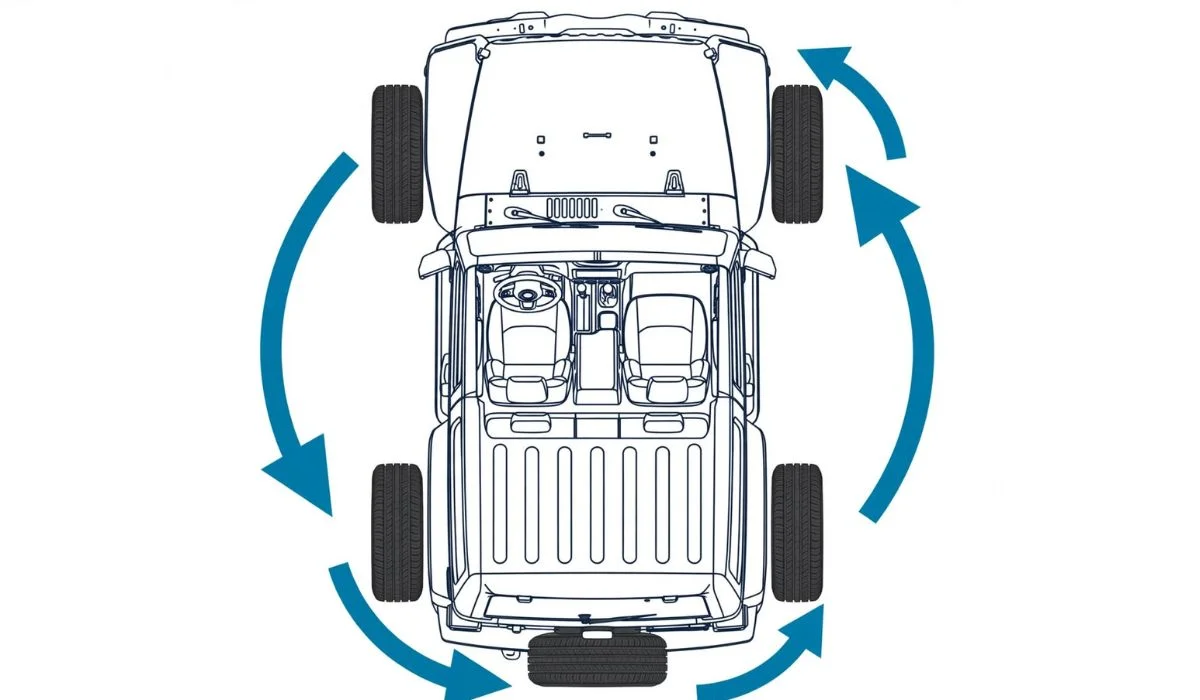
For a Wrangler using the rearward-cross approach, the basic four-wheel rotation is:
| Current Position | New Position |
|---|---|
| Left Rear | Left Front |
| Right Rear | Right Front |
| Left Front | Spare |
| Right Front | Left Rear |
| Spare | Right Rear |
The important point is that the rear tires move straight forward, while the front tires cross toward the rear. The spare then enters the cycle. This follows the rearward-cross concept used in Jeep’s Wrangler maintenance guidance and the general five-tire rearward-cross pattern for rear-wheel-drive/4WD vehicles.
Simple Wrangler 5-Tire Rotation Diagram
Think of the movement like this:
Left Rear → Left Front → Spare → Right Rear → Right Front → Left Rear
That creates a continuous five-position cycle.
However, because tire manufacturers and vehicle configurations can differ, don’t rely on a generic internet diagram if your Wrangler has a special tire setup.
Rearward Cross vs. Forward Cross
You’ll find both forward-cross and rearward-cross five-tire diagrams online.
They are not automatically interchangeable for every vehicle.
For a Wrangler, Jeep’s owner manuals identify rearward cross as the suggested rotation method.
That’s why the safest approach is:
- Identify your Wrangler’s model year.
- Check the owner’s manual.
- Confirm whether the spare matches the road tires.
- Check whether the tires are directional.
- Follow the tire manufacturer’s restrictions if applicable.
How to Perform a 5-Tire Rotation:

Before starting, park the Wrangler on a firm, level surface and make sure it is securely supported. If you’re not experienced with lifting a vehicle, having a qualified tire technician perform the rotation is the safer option.
Step 1: Identify All Five Tires
Label each tire before removing anything.
For example:
- LF
- RF
- LR
- RR
- S
This prevents confusion when you move multiple tires around the Jeep.
Step 2: Inspect the Tires
Don’t simply move the tires immediately.
Look for:
- Uneven tread wear
- Cuts
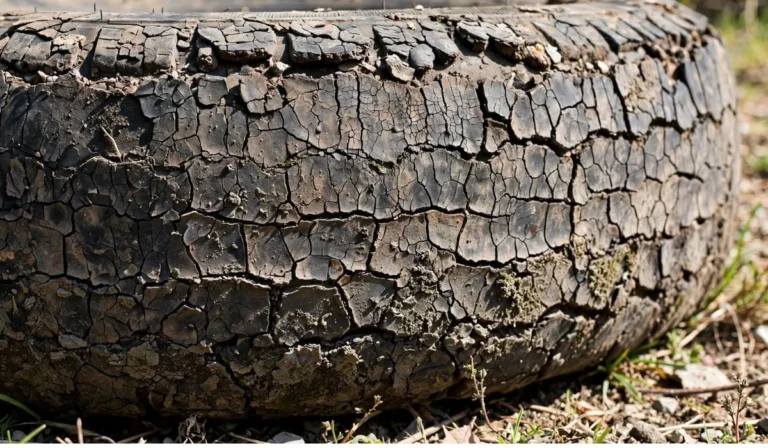
- Cracks
- Bulges
- Embedded objects
- Cupping
- Excessive shoulder wear
- Abnormal tread patterns
If one tire has serious damage or unusual wear, find the cause before completing the rotation. Jeep specifically advises correcting the reason for rapid or unusual wear before rotating the tires.
Step 3: Follow the Rearward-Cross Pattern
Move each tire to its new position according to the appropriate five-tire pattern for your Wrangler.
The key is to move the tires systematically rather than simply swapping front and rear tires.
Step 4: Check Tire Pressure
After the tires are installed in their new positions, check and adjust tire pressures according to the vehicle’s specified recommendations.
Don’t assume the pressure written on the tire sidewall is the correct operating pressure for your Wrangler.
Step 5: Tighten the Lug Nuts Correctly
Use the manufacturer’s specified lug-nut torque rather than guessing.
A torque wrench is especially useful when doing the work yourself.
After installation, verify that the wheels are securely fastened before driving.
Read Next: How To Deep Clean Car Seats | Built-Up Grime
When Should You Rotate Jeep Wrangler Tires?
The exact interval should come from your Wrangler owner’s manual and your tire manufacturer’s recommendations.
Mopar notes that tire rotation helps compensate for the different loads and functions experienced by front and rear tires and recommends following the manufacturer’s specified maintenance schedule.
Your driving conditions can also influence how quickly the tires wear.
Rotate More Carefully If You Drive Off-Road
Wrangler owners who frequently drive on:
- Rocks
- Sand
- Mud
- Gravel
- Trails
- Rough roads
may see different or faster tread wear than someone who primarily drives on pavement.
Aggressive off-road tread designs can particularly benefit from timely rotation because rotation helps distribute wear. Jeep specifically highlights the benefit of rotation for On/Off Road-type tread designs.
Does Every Jeep Wrangler Use a 5-Tire Rotation?
No.
A Wrangler can have different tire configurations, and the spare isn’t automatically suitable for rotation simply because it is mounted on the rear of the vehicle.
The spare should be appropriate for use with the other four tires.
Check Whether the Spare Matches
Before including the spare, check:
- Tire size
- Tire construction
- Tire type
- Tread pattern
- Direction of rotation
- Wheel compatibility
- Overall circumference
If the spare is a temporary or compact spare, it should not be treated like a normal full-size road tire. Jeep’s manuals distinguish compact/temporary spares from matching full-size spare tires.
What About a Full-Size Matching Spare?
A full-size spare matching the road tires can potentially be incorporated into the rotation.
Jeep documentation notes that some Wranglers have a spare tire and wheel equivalent in look and function to the original equipment tire and wheel, and such a spare may be used in tire rotation.
What If Your Wrangler Has Directional Tires?
Directional tires require extra attention.
A directional tire is designed to rotate in one specific direction. Moving it to the opposite side of the Jeep can reverse its intended direction unless the tire is removed from the wheel and remounted correctly.
Check the Sidewall Arrow
Look for an arrow or wording indicating the tire’s required rotation direction.
If the tire is directional, don’t blindly apply a standard five-tire cross pattern.
Tire manufacturers specifically warn that directional tires must maintain their intended direction of rotation.
In this situation, ask a tire professional to determine the appropriate rotation procedure.
What If the Tires Have Different Sizes?
A five-tire rotation is generally intended for a matching set.
If your Wrangler has different tire sizes between axles, the normal five-tire pattern may not be appropriate.
This is particularly important with 4WD systems because tire circumference differences can create drivetrain problems. Jeep explicitly cautions that proper 4WD operation depends on equal tire size, type, and circumference at each wheel.
Don’t Force a Rotation Pattern
If one tire is:
- A different size
- A different construction
- A temporary spare
- Significantly more worn
- Directional
- Not approved for regular road use
don’t force it into the five-tire rotation.
Check the Wrangler owner’s manual and tire manufacturer’s instructions first.
5-Tire vs. 4-Tire Rotation
The biggest difference is simple: a four-tire rotation leaves the spare out of the cycle.
With a five-tire rotation, the spare becomes one of the regularly used tires.
| Feature | 4-Tire Rotation | 5-Tire Rotation |
|---|---|---|
| Tires rotated | 4 | 5 |
| Spare included | No | Yes |
| Spare accumulates mileage | No | Yes |
| Wear distribution | Four tires | Five tires |
| Best for matching full-size spare | Less useful | More useful |
| Requires matching spare | No | Yes |
A five-tire rotation can be particularly attractive for Wrangler owners with a matching full-size spare because it prevents the spare from remaining virtually unused while the other four tires wear down.
Common Jeep Wrangler Tire Rotation Mistakes
Even a simple rotation can go wrong if the pattern or tire type isn’t considered.
Using a Generic Jeep Diagram
Not every Jeep has the same tire configuration.
Always prioritize your specific Wrangler owner’s manual over a generic diagram found online.
Rotating a Temporary Spare
A temporary spare isn’t equivalent to a normal road tire.
Don’t include a compact or limited-use spare in a regular five-tire rotation unless the manufacturer specifically says it is suitable.
Ignoring Directional Tires
Crossing directional tires from one side to another can change their intended rolling direction.
Check the sidewall before rotating.
Mixing Different Tread Depths
Putting a brand-new tire into a 4WD system alongside substantially worn tires can create circumference differences.
This is one reason Jeep stresses maintaining equal tire size, type, and circumference.
Forgetting the Spare’s Pressure
Because the spare spends much of its time sitting on the back of the Jeep, it’s easy to forget about its pressure.
Include the spare in your regular tire-pressure inspections.
Does Tire Rotation Improve Wrangler Handling?
It can help maintain more consistent tread wear, which may contribute to predictable traction and handling.
Jeep states that timely rotation can increase tread life, help maintain mud, snow, and wet traction, and contribute to a smoother, quieter ride.
However, tire rotation cannot correct every handling problem.
If your Wrangler pulls to one side, vibrates excessively, or develops unusual wear, the problem could involve alignment, balancing, suspension components, tire damage, or another mechanical issue.
How to Know Your Wrangler Needs More Than a Rotation
Rotation isn’t a cure for abnormal tire wear.
Have the Jeep inspected if you notice:
- Steering-wheel vibration
- Vehicle pulling to one side
- Severe cupping
- Feathered tread
- Rapid tread loss
- Uneven shoulder wear
- Repeated tire-pressure loss
- Cracks or bulges
- Drivetrain vibration
A tire professional can determine whether alignment, balancing, suspension inspection, or tire replacement is necessary.
Quick Jeep Wrangler 5-Tire Rotation Checklist
Before finishing the job, run through this checklist:
☐ Confirm all five tires are suitable for rotation
☐ Verify tire sizes match
☐ Check whether the tires are directional
☐ Inspect tread and sidewalls
☐ Identify LF, RF, LR, RR, and spare
☐ Follow the Wrangler’s recommended rearward-cross pattern
☐ Check tire pressure
☐ Torque lug nuts to specification
☐ Inspect the spare
☐ Test-drive carefully after installation
Final Thoughts on the Jeep Wrangler 5 Tire Rotation Pattern
The Jeep Wrangler 5 tire rotation pattern is designed to keep wear distributed across the complete tire set when a matching full-size spare is suitable for rotation. For Wrangler models covered by the current owner-manual guidance, Jeep specifies the rearward-cross method for tire rotation.
The most important rule is not to copy a generic five-tire diagram without checking your actual tires. Directional tires, different tire sizes, temporary spares, and substantially different tread depths can change what is appropriate.
For a standard Wrangler with five matching, non-directional tires, following the vehicle-specific instructions and maintaining consistent tire size, type, and circumference is the safest approach.
FAQs
What is the Jeep Wrangler 5 tire rotation pattern?
For a Wrangler using the rearward-cross method, the rear tires move forward on the same side, while the front tires cross toward the rear; the spare is incorporated into the five-position cycle when it is a suitable matching full-size tire. Jeep’s owner manual identifies rearward cross as the suggested method.
Should I rotate all five tires on my Jeep Wrangler?
If your Wrangler has a matching full-size spare that is suitable for regular road use and rotation, using all five tires can help distribute wear more evenly. Always verify your specific tire and vehicle configuration first.
Is the Jeep Wrangler rotation pattern forward cross or rearward cross?
Jeep’s Wrangler owner manuals specify rearward cross as the suggested rotation method.
Can I include a compact spare in a 5-tire rotation?
No. A compact or temporary spare should not be treated like a normal full-size road tire. Check the spare’s markings and your owner’s manual before using it in rotation.
Can directional tires be used in a five-tire cross rotation?
Not in the same way as standard non-directional tires. Directional tires need to maintain their specified direction of rotation, so a cross-side move may require remounting the tire.
Why does tire circumference matter on a Wrangler?
Wrangler 4WD operation depends on tires having equal size, type, and circumference. Significant differences can place stress on the drivetrain and may damage the transfer case.
How often should I rotate Wrangler tires?
Follow the maintenance interval specified for your particular Wrangler and tire setup. Driving style, road conditions, tire design, and off-road use can affect wear, so inspect the tires regularly rather than relying only on mileage.
Should I rotate my Wrangler’s spare tire?
If it is a matching full-size spare approved for regular use, incorporating it into a five-tire rotation can prevent it from remaining unused while the other tires wear.
Does rotating five tires make the tires last longer?
A five-tire rotation distributes use across five tires rather than four, which can help equalize tread wear and prevent the spare from aging unused. Actual tire life still depends on the tire, driving conditions, maintenance, alignment, and wear rate.
What should I do if my Wrangler tires wear unevenly?
Don’t simply rotate them and ignore the cause. Jeep recommends correcting the reason for rapid or unusual wear before performing the rotation. Possible causes include alignment, balancing, suspension problems, incorrect pressure, or tire damage.