
Driving On New Tires Without Alignment | Warning Signs, and How Long You Can Safely Drive Before an Alignment

Driving on new tires without alignment is not automatically dangerous, but it can become a problem when the vehicle’s wheel alignment is incorrect. New tires have fresh tread and are designed to provide proper traction, but an alignment problem can cause them to wear unevenly much faster than expected.
Wheel alignment refers to the adjustment of the vehicle’s suspension angles that control how the wheels contact and track along the road. The primary alignment angles are generally toe, camber, and caster.
If the vehicle was properly aligned before the tire installation and there are no symptoms of an alignment problem, installing new tires does not automatically mean an alignment is required. However, if the old tires showed uneven wear, the steering wheel was off-center, or the vehicle pulled to one side, alignment should be checked before putting significant mileage on the new tires.
Can You Drive on New Tires Without an Alignment?
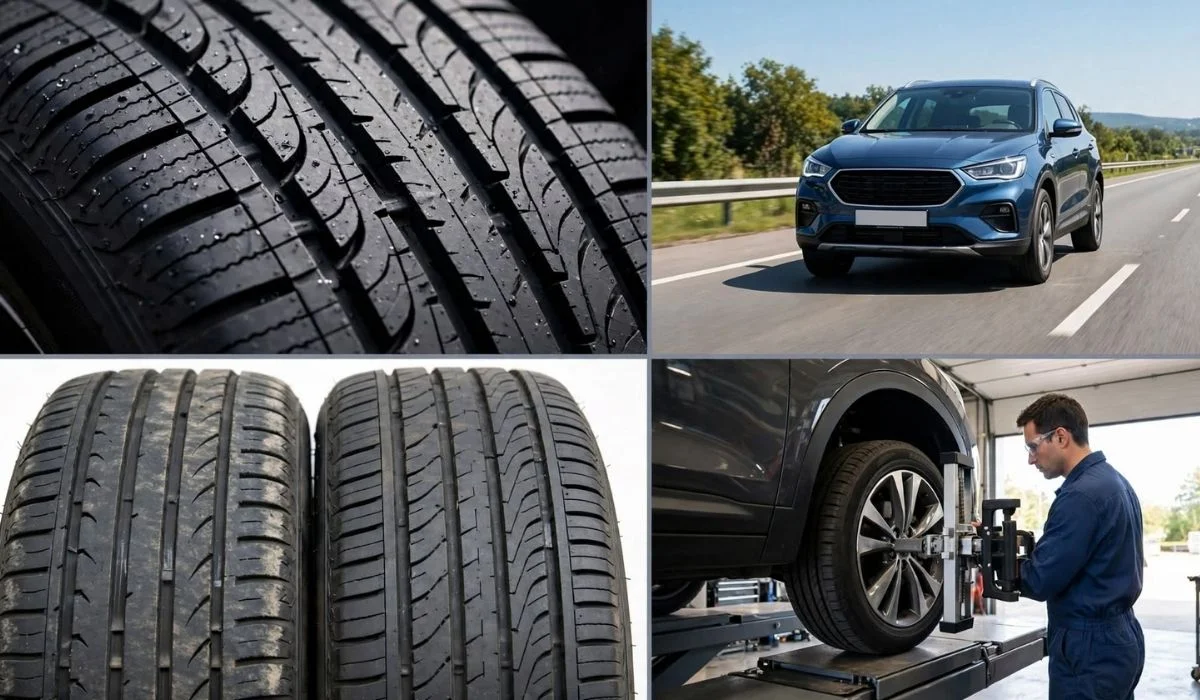
Yes, you can generally drive a short distance on new tires without immediately performing an alignment if the vehicle does not have an existing alignment problem.
However, if the wheels are misaligned, continuing to drive can cause the new tires to wear unevenly.
The important distinction is this:
- New tires do not create an alignment problem.
- An existing alignment problem can damage new tires through abnormal wear.
- Replacing tires does not correct wheel alignment.
- A tire installation does not automatically require alignment in every situation.
If the old tires were evenly worn and the vehicle drives straight with a centered steering wheel, an alignment may not be necessary solely because new tires were installed.
Why Alignment Matters With New Tires
A tire’s tread is designed to contact the road evenly.
When the wheels are positioned at incorrect angles, some parts of the tread can carry more load than others. This can produce accelerated or irregular wear.
A new tire has its maximum usable tread when installed. If alignment is significantly incorrect, that fresh tread can begin wearing abnormally almost immediately.
Toe Alignment Can Cause Rapid Wear
Toe describes whether the front edges of the tires point slightly toward or away from each other when viewed from above.
Incorrect toe can be particularly hard on tires because the tread may be forced to scrub across the pavement instead of rolling smoothly.
Signs can include:
- Feathered tread
- Rapid wear
- Steering instability
- Steering wheel changes
- Tire noise
Because toe-related problems can produce relatively rapid tread wear, they should be addressed promptly.
Camber Affects Inner and Outer Edge Wear
Camber describes the inward or outward tilt of the wheel when viewed from the front of the vehicle.
Excessive negative camber can contribute to wear on the inner edge, while excessive positive camber can contribute to outer-edge wear.
However, tire wear patterns should not be used alone to diagnose the exact alignment problem. Suspension components, tire pressure, and other factors can produce similar patterns.
Caster Mainly Influences Steering Behavior
Caster relates to the steering axis angle when viewed from the side.
Caster generally has a major influence on:
- Steering stability
- Steering-wheel return
- Straight-line tracking
- Steering feel
Caster is not usually the first alignment angle people associate with simple tread-edge wear, but an incorrect caster setting can affect how the vehicle tracks and handles.
What Happens If You Drive New Tires With Bad Alignment?

If the vehicle has significant alignment problems, the consequences can extend beyond tire wear.
Uneven Tread Wear
One section of the tire can wear much faster than the rest.
Instead of getting consistent mileage from the new tires, you may notice:
- Inner-edge wear
- Outer-edge wear
- Feathering
- Cupping or scalloping
- Patchy wear
Once severe uneven wear develops, an alignment adjustment cannot restore the tread that has already been lost.
Reduced Tire Lifespan
New tires can be expensive, so premature wear can turn an alignment issue into a significant maintenance cost.
For example, a tire designed to provide many thousands of miles of service may lose useful tread substantially earlier if the vehicle continually operates with incorrect alignment.
The exact amount of premature wear cannot be predicted simply from the number of miles driven.
Steering and Handling Problems
A misaligned vehicle may:
- Pull to one side
- Wander on the road
- Require constant steering correction
- Have an off-center steering wheel
- Feel unstable during braking
- Handle differently on uneven roads
These symptoms should be investigated rather than ignored.
How Long Can You Drive New Tires Without Alignment?

There is no universal mileage limit such as 50, 100, or 500 miles.
A vehicle with a minor alignment deviation may behave differently from one with a severe suspension or alignment problem.
If alignment is known to be incorrect, the best approach is to have it checked as soon as reasonably possible rather than deliberately driving a certain number of miles first.
A short drive to a tire or repair shop may be reasonable when the vehicle is otherwise operating normally. Long-distance driving on a vehicle with obvious pulling, severe vibration, or rapidly worsening tire wear is a different situation.
Do New Tires Need an Alignment?
New tires themselves do not automatically require an alignment.
Alignment should be considered when:
- The old tires had uneven wear.
- The vehicle pulls left or right.
- The steering wheel is not centered.
- The vehicle recently hit a pothole or curb.
- Suspension or steering components were replaced.
- The vehicle has been in a collision.
- New tires produce unusual handling.
- The vehicle has known alignment issues.
If none of these conditions apply, an alignment may not be necessary just because the tires are new.
When Should You Get an Alignment After Installing New Tires?
If an alignment is recommended based on the vehicle’s condition, doing it before driving significant mileage on the new tires is preferable.
This protects the fresh tread from unnecessary wear.
A particularly good time to check alignment is when replacing tires that show a suspicious wear pattern.
Ask for an Alignment Check Before Paying for Adjustment
An alignment check and an alignment adjustment are not exactly the same thing.
A shop can measure the vehicle’s alignment angles and determine whether they fall within the manufacturer’s specified ranges.
If the measurements are acceptable, an adjustment may not be necessary.
This can prevent unnecessary work.
Read Next: How To Jumpstart A Car By Yourself | Step-by-Step Guide
Signs You Should Not Ignore After Installing New Tires
Sometimes a problem becomes more noticeable after new tires are installed because the vehicle now has fresh tread and different tire characteristics.
Watch for these symptoms.
The Vehicle Pulls to One Side
A vehicle that consistently drifts or pulls to one side may have an alignment issue, but tire pressure, road crown, tire characteristics, braking components, or suspension problems can also contribute.
Check tire pressures first and have the vehicle inspected if the pulling continues.
The Steering Wheel Is Crooked
If the steering wheel remains noticeably off-center while the vehicle is traveling straight, alignment should be checked.
This can be a sign that the steering and suspension geometry is not properly centered.
The Tires Become Noisy
Uneven tread wear can create increased road noise.
However, not every tire noise indicates bad alignment. Tire design, road surface, inflation pressure, wheel bearings, and suspension components can also influence noise.
The New Tires Show Uneven Wear
This is one of the strongest reasons to have the vehicle inspected.
Do not wait until the tire is visibly ruined. Early detection can prevent unnecessary loss of tread.
Can Bad Alignment Damage New Tires Quickly?
Yes.
The speed of wear depends on how far the alignment is outside the manufacturer’s specifications and how the vehicle is driven.
A severe toe problem, for example, can create noticeable tread wear relatively quickly because the tires are not rolling in the intended direction.
Aggressive cornering, heavy loads, high speeds, and rough roads can make the consequences more pronounced.
There is no reliable formula that says an alignment problem will damage a tire after exactly a certain number of miles.
Alignment vs. Tire Balancing: What Is the Difference?
These two services are often confused.
| Alignment | Tire Balancing |
|---|---|
| Adjusts wheel/suspension geometry | Corrects weight distribution around the wheel and tire |
| Can address pulling and uneven wear | Can address vibration caused by imbalance |
| Involves toe, camber, caster and related geometry | Uses balancing weights to correct rotational imbalance |
| Helps tires track correctly | Helps the wheel and tire rotate smoothly |
A new tire installation commonly includes balancing, but alignment is a separate service.
A vehicle can have properly balanced new tires and still have poor alignment.
Why a Car Can Pull Even After an Alignment
Alignment is not the only possible cause of pulling.
Other possibilities include:
- Unequal tire pressure
- Tire conicity or tire pull
- Uneven tire wear
- Brake drag
- Suspension problems
- Road crown
- Damaged steering components
If a vehicle continues to pull after an alignment, the technician should investigate other potential causes rather than repeatedly adjusting alignment without finding the reason.
What Should You Check After Buying New Tires?
A quick inspection can help catch problems early.
New-Tire Checklist
Check:
- Correct tire size
- Correct load rating
- Correct speed rating
- Tire pressure
- Wheel-nut torque
- Valve condition
- Tread appearance
- Steering behavior
- Wheel balance
- Alignment condition
The vehicle manufacturer’s specifications should be used for tire pressure and other vehicle-specific requirements.
What If You Just Installed New Tires and Notice Pulling?
Do not assume that the new tires are defective or that alignment is definitely the cause.
Start with the simplest checks.
- Verify tire pressure on all four tires.
- Check that the tire sizes match the vehicle requirements.
- Observe whether the vehicle pulls consistently.
- Check whether the steering wheel is centered.
- Return to the tire shop for an inspection if the issue persists.
The shop can check tire installation, balance, alignment, and other potential causes.
Should You Align All Four Wheels?
Whether a vehicle receives a two-wheel or four-wheel alignment depends on its suspension design and manufacturer specifications.
Many modern vehicles require measurement of all relevant wheels even when only certain angles are adjustable.
A proper alignment service should follow the vehicle manufacturer’s specifications rather than applying one universal adjustment procedure to every vehicle.
Does Replacing One Tire Require Alignment?
Replacing one tire does not automatically mean the vehicle needs an alignment.
However, the reason the tire was replaced matters.
If the previous tire was damaged because of a pothole or collision, the impact may also have affected suspension or alignment components.
If the tire simply suffered a normal puncture that was not associated with an impact, alignment may not be necessary.
Can Potholes Knock a Car Out of Alignment?
Yes.
A significant pothole or curb impact can affect wheel alignment and, in some cases, damage suspension or steering components.
After a major impact, look for:
- Steering wheel misalignment
- Pulling
- New vibrations
- Uneven tire wear
- Strange noises
- Changes in handling
If these symptoms appear, have the vehicle inspected.
How to Protect New Tires From Premature Wear
Good maintenance can help you get the expected service life from your tires.
Follow a Simple Maintenance Routine
- Maintain recommended tire pressure.
- Rotate tires according to the manufacturer’s schedule.
- Check alignment when symptoms appear.
- Avoid unnecessary pothole and curb impacts.
- Inspect tread regularly.
- Correct suspension problems promptly.
- Have unusual vibrations investigated.
- Avoid carrying loads beyond the vehicle’s rating.
Tire maintenance is most effective when problems are identified before they become severe.
Is It Worth Getting an Alignment With Every New Set of Tires?
It can be worthwhile to have the alignment checked when installing new tires, particularly if the old tires showed uneven wear or the vehicle has handling symptoms.
But checking alignment is different from automatically paying for an adjustment.
If measurements are within the manufacturer’s specifications and the vehicle has no relevant symptoms, an adjustment may not provide any benefit.
Final Verdict: Driving on New Tires Without Alignment
Driving on new tires without alignment is generally acceptable when the vehicle has no signs of an alignment problem. New tires do not inherently require an alignment.
The situation changes if the vehicle pulls, the steering wheel is off-center, the previous tires wore unevenly, or the car recently hit a pothole or curb. In those cases, an alignment check should be performed promptly.
The biggest concern is not that the new tires will suddenly fail because an alignment was not performed. The concern is that an existing alignment problem can cause premature and uneven tread wear, reducing the useful life of an expensive new set.
If you suspect an alignment issue, checking it early is usually far less costly than discovering it after thousands of miles of uneven tire wear.
FAQs About Driving on New Tires Without Alignment
Can I drive new tires immediately without an alignment?
Yes, if the vehicle has no known alignment problem and drives normally. An alignment is not automatically required every time tires are replaced.
How many miles can I drive on new tires before an alignment?
There is no universal mileage limit. If the vehicle has a known alignment problem, have it checked as soon as possible instead of intentionally driving hundreds or thousands of miles first.
Will new tires wear out if I don’t get an alignment?
Not necessarily. If the vehicle’s alignment is already correct, skipping an alignment adjustment will not automatically damage the tires. If alignment is incorrect, however, premature uneven wear can occur.
Do new tires change wheel alignment?
Normally, installing new tires does not change the vehicle’s suspension alignment angles. However, new tires can sometimes make existing handling or wear problems more noticeable.
Should I get an alignment before or after new tires?
If the vehicle needs both services, alignment is generally best performed with the new tires installed so the vehicle can be properly checked and adjusted while the fresh tires are on the vehicle.
How do I know if my car needs an alignment?
Common signs include pulling to one side, an off-center steering wheel, uneven tire wear, abnormal handling, or changes after hitting a pothole or curb.
Can bad alignment ruin new tires?
Yes. Significant alignment problems can cause rapid or uneven tread wear. The exact rate depends on the severity of the problem and driving conditions.
Is tire balancing the same as alignment?
No. Balancing addresses uneven weight distribution in the wheel-and-tire assembly, while alignment concerns the geometry that determines how the wheels are positioned and track on the road.
Can low tire pressure cause a car to pull?
Yes. Unequal tire pressure can contribute to pulling or handling differences. Check tire pressure before assuming the problem is caused by alignment.
Do I need an alignment after hitting a pothole?
Not every pothole impact causes an alignment problem. However, if you notice pulling, an off-center steering wheel, vibration, unusual noise, or new uneven wear afterward, an alignment and suspension inspection is advisable.
Why are my new tires wearing unevenly?
Possible causes include improper alignment, incorrect tire pressure, lack of rotation, worn suspension components, wheel imbalance, or other vehicle-related problems. A professional inspection can identify the specific cause.
Can I get an alignment with worn tires?
An alignment can be measured with worn tires, but severely or unevenly worn tires may need replacement. If new tires are already planned, aligning the vehicle with the new set can help protect the fresh tread.
Is an alignment necessary after changing only two tires?
Not automatically. The need depends on the vehicle’s condition and whether there are symptoms or evidence of alignment problems. Checking the alignment can be useful if the old tires had abnormal wear.