
How to Change a Flat Tire Without a Jack | Safe Methods & Tips

Getting a flat tire without a jack can leave you wondering how to change a flat tire without a jack and whether there is a safe workaround. For most cars, replacing the flat wheel with a spare requires lifting the vehicle, so attempting to remove the wheel while it is supporting the vehicle’s weight is dangerous. However, depending on the type of tire damage, you may have other options, such as using a manufacturer-approved tire sealant, an emergency tire-inflation kit, or calling roadside assistance.
The right solution depends on whether the tire has a small tread puncture, a completely deflated tire, sidewall damage, or a damaged wheel.
Can You Change a Flat Tire Without a Jack?
For a conventional vehicle, you normally cannot safely replace a flat tire without some form of suitable lifting equipment.
The wheel must be raised enough for the tire to clear the ground before you can remove the lug nuts and wheel.
Trying to loosen and remove a wheel while it is still carrying the vehicle’s weight can create serious safety risks.
Why a Jack Is Normally Necessary
A vehicle jack is designed to lift the vehicle at specific manufacturer-approved lifting points.
Once the wheel is off the ground, the lug nuts can be removed and the flat tire can be replaced with the spare.
Without a suitable lifting device, there is no safe way to create the necessary clearance on most passenger vehicles.
What Can You Do Instead of Changing the Tire?
If you don’t have a jack, your first priority should be getting the vehicle into a safe location and determining whether the tire can be temporarily repaired without removing the wheel.
Possible options include:
- Roadside assistance
- A mobile tire service
- A tire-inflation kit
- Manufacturer-approved tire sealant
- A plug repair for an appropriate tread puncture
- A run-flat tire, if your vehicle is equipped with one
- A nearby tire shop
The correct choice depends on the tire and the nature of the damage.
Move to a Safe Location First
A flat tire should be treated as a roadside safety problem before it becomes a tire-repair problem.
If the tire goes flat while driving, gradually reduce speed and move to a safe location when possible.
Avoid Stopping in a Dangerous Position
If possible, stop:
- Away from moving traffic
- On firm, level ground
- On a stable shoulder
- Away from blind curves
- Away from intersections
- Away from soft or unstable surfaces
Turn on your hazard lights.
If you’re on a highway or another high-speed road and cannot safely exit the vehicle, contacting roadside assistance may be safer than attempting a roadside repair.
Check What Type of Flat You Have
Not every flat tire requires the same response.
A small puncture in the center tread is very different from a destroyed sidewall.
Small Tread Puncture
A small puncture caused by something such as a nail or screw may sometimes be temporarily repaired with an appropriate tire repair kit.
However, the tire must be suitable for repair.
A temporary repair should not be treated as permission to ignore professional inspection.
Sidewall Damage
A cut, tear, bulge, or significant puncture in the sidewall generally cannot be safely repaired with a conventional plug.
In this situation, don’t attempt an improvised repair.
A spare tire or professional tire service is usually necessary.
Can You Use a Tire Inflator Instead of a Jack?
Sometimes.
If the tire has simply lost air because of a slow puncture, an air compressor or portable inflator may allow you to restore pressure temporarily.
This doesn’t actually fix the puncture.
When Inflation May Help
Inflating the tire may be useful when:
- The puncture is small
- The tire is otherwise undamaged
- The tire hasn’t been driven extensively while severely underinflated
- The manufacturer permits continued driving after inflation
- You only need enough pressure to reach an appropriate repair facility
Never drive on a tire that remains dangerously underinflated.
Can Tire Sealant Fix a Flat Without a Jack?
Some emergency tire sealants are designed to temporarily seal certain small punctures without removing the wheel.
This can be useful when a vehicle doesn’t have a traditional spare or jack.
Check the Vehicle Manufacturer’s Instructions
Not every tire or vehicle is compatible with every sealant.
Some vehicles use tire-pressure monitoring systems that may be affected by certain products, and some tire manufacturers have specific restrictions regarding sealants.
Read the instructions for your particular vehicle and product before using one.
Can You Plug a Flat Tire Without a Jack?
A suitable tread puncture can sometimes be repaired with an external tire plug kit without removing the wheel.
However, this is not appropriate for every puncture.
When a Plug May Be Appropriate
A puncture repair may be possible when the damage is:
- Small
- Located in the repairable tread area
- Caused by a suitable puncturing object
- Not associated with major internal damage
Tire repair standards and manufacturer recommendations should be followed.
A professional tire technician should inspect the tire to determine whether it is actually repairable.
Don’t Repair a Tire With Sidewall Damage
This is one of the most important rules when dealing with a flat tire.
The sidewall flexes substantially while the vehicle is moving, so damage in this area can compromise the tire’s structural integrity.
Signs the Tire Should Not Be Repaired
Do not rely on a temporary puncture repair if you see:
- Sidewall cuts
- Large tears
- Bulges
- Exposed cords
- Severe cracking
- Significant impact damage
- A damaged bead
In these situations, arrange for professional tire replacement or roadside assistance.
What If Your Car Has Run-Flat Tires?
A vehicle equipped with run-flat tires may not require an immediate spare-tire change after certain punctures.
Run-flat tires are specifically designed to provide limited mobility after losing air, subject to the tire manufacturer’s speed and distance limitations.
Follow the Run-Flat Limitations
Don’t assume you can drive indefinitely on a run-flat tire.
The manufacturer’s instructions typically specify limitations concerning:
- Maximum speed
- Maximum distance
- Tire condition
- Vehicle load
- Driving conditions
If the tire has severe physical damage, even a run-flat may require immediate replacement.
Read Next: Tubeless vs Tube Tires | Key Differences, Pros, Cons & Which Is Better
Can You Remove the Wheel Without a Jack?

You should not attempt to remove a conventional vehicle wheel while the tire is still supporting the vehicle.
The vehicle’s weight can make wheel removal difficult and create a serious risk of the vehicle moving or falling.
Don’t Use Improvised Lifting Methods
Avoid trying to lift the vehicle with:
- Bricks
- Wooden blocks not designed for vehicle support
- Household furniture
- Rocks
- Unapproved ramps
- Another vehicle
- Makeshift levers
These methods can fail suddenly.
A vehicle should only be lifted using equipment designed and rated for the vehicle.
What If You Have a Jack but It Doesn’t Work?
If you have a jack that is damaged, unstable, missing parts, or unsuitable for your vehicle, don’t improvise.
A proper replacement jack or professional assistance is the safer solution.
Never Work Under a Vehicle Supported Only by a Jack
This rule is especially important.
A jack is intended to lift a vehicle, not necessarily to serve as the sole support while someone works underneath it.
For repairs requiring access beneath the vehicle, appropriately rated jack stands or professional equipment are necessary.
For a simple tire change, follow the vehicle manufacturer’s instructions for the supplied jack and wheel-changing procedure.
How to Get a Flat Tire Fixed Without a Jack:
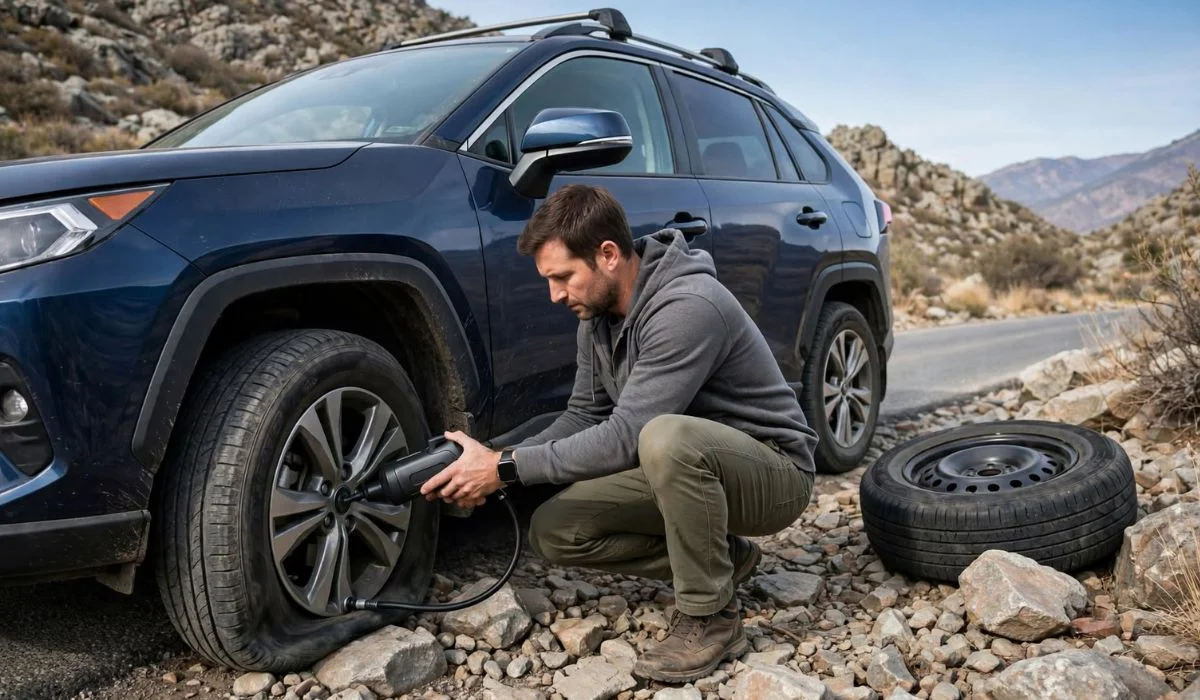
If you don’t have a jack and can’t safely repair the puncture from the outside, calling a professional is often the simplest option.
Roadside Assistance
Roadside assistance can provide:
- Spare-tire installation
- Tire inflation
- Tire repair assessment
- Towing
- Mobile tire service
Many vehicle manufacturers, insurance companies, automobile clubs, and roadside service providers offer some form of roadside assistance.
What Tools Are Useful for a No-Jack Emergency?
Even though these tools don’t replace a jack for changing a wheel, keeping an emergency tire kit in the vehicle can be helpful.
Consider carrying:
- Portable tire inflator
- Tire-pressure gauge
- Manufacturer-approved sealant
- Emergency puncture-repair kit
- Reflective warning equipment
- Flashlight
- Gloves
- Vehicle owner’s manual
Check Your Spare-Tire Equipment
If your vehicle came with a spare tire, check whether it also includes:
- Vehicle jack
- Lug wrench
- Jack handle
- Wheel chock
- Locking-wheel-nut key, if applicable
It’s better to discover missing equipment at home than beside a highway with a flat tire.
Can You Drive on a Flat Tire to a Tire Shop?
Generally, you should not drive on a completely flat conventional tire.
Driving on a flat tire can damage the tire internally and potentially damage the wheel.
It can also negatively affect vehicle control.
What About a Slightly Low Tire?
If the tire is only slightly low and you can safely inflate it to the manufacturer’s recommended pressure, the situation may be different.
But if the tire immediately loses pressure again, don’t continue driving on it.
How to Prevent Being Stranded Without a Jack?
The best solution is preparation.
Before a long trip, inspect your emergency equipment.
Keep Your Tire Equipment Ready
Make sure your vehicle has either:
- A usable spare tire and jack
- A functioning tire repair/inflation system
- Run-flat tires with appropriate roadside provisions
- A roadside assistance plan
Also check the condition and pressure of your spare tire periodically.
A Safer Emergency Decision Guide
If you’re currently dealing with a flat tire and have no jack, use this approach:
Small tread puncture: Consider an appropriate temporary puncture repair or inflation solution if the tire manufacturer permits it.
Slow leak: Inflate only enough to reach a safe repair location if the tire remains suitable for driving.
Completely flat tire: Don’t drive on it. Call roadside assistance or arrange professional tire service.
Sidewall damage: Don’t attempt a plug or sealant repair. Get professional assistance.
Run-flat tire: Follow the manufacturer’s specified speed and distance limits.
Damaged wheel: Don’t continue driving. Arrange professional assistance.
Final Takeaway
Learning how to change a flat tire without a jack is useful, but for most conventional vehicles, there isn’t a safe substitute for proper lifting equipment when you need to remove the wheel.
If the problem is a small, repairable tread puncture, an appropriate temporary repair kit or tire inflator may help you avoid removing the wheel. If the tire has serious damage, is completely flat, or cannot safely be repaired from the outside, roadside assistance or a mobile tire professional is the safer choice.
Most importantly, never use improvised objects to lift a vehicle. A failed lifting method can cause severe injury or vehicle damage. When in doubt, don’t attempt the wheel change without the proper equipment.
FAQs
Can you change a tire without a jack?
For most conventional cars, not safely. The vehicle needs to be lifted so the wheel can be removed. Without a suitable jack or other properly rated lifting equipment, roadside assistance is the safer option.
What can I use instead of a car jack?
Use only lifting equipment specifically designed and rated for your vehicle. Don’t substitute bricks, rocks, furniture, or other improvised objects.
Can I fix a flat tire without removing it?
Sometimes. A suitable small tread puncture may be temporarily repaired with an appropriate tire plug kit, or a slow leak may temporarily be addressed with an inflator or manufacturer-approved sealant.
Can I drive a car with a completely flat tire?
You generally should not drive on a completely flat conventional tire. Doing so can cause additional tire and wheel damage and may compromise vehicle control.
Can tire sealant fix a flat without a jack?
Some emergency sealants can temporarily seal certain small punctures without removing the wheel. Check the product instructions and your vehicle and tire manufacturer’s recommendations first.
Can you plug a tire while it is still on the car?
Certain external plug kits are designed for temporary repair of appropriate tread punctures while the wheel remains installed. However, not every puncture is repairable, and professional inspection is recommended.
Can a sidewall puncture be repaired without a jack?
A sidewall puncture generally should not be repaired with a conventional tire plug. Professional assessment and often tire replacement are necessary.
What if my car has no spare tire or jack?
Check whether your vehicle has a tire repair/inflation kit, run-flat tires, or roadside assistance coverage. If none is suitable for the situation, contact a professional roadside service.
Is it safe to change a tire on the side of a highway?
Changing a tire beside fast-moving traffic can be dangerous. If you cannot reach a genuinely safe location, staying in a protected position and contacting roadside assistance may be safer than attempting the repair yourself.
Can I use another car to lift my vehicle?
No. Do not use another vehicle as an improvised lifting system. Use equipment specifically designed and rated for lifting and supporting your vehicle.
How can I prepare for a flat tire if I don’t have a jack?
Keep a portable tire inflator, pressure gauge, appropriate emergency repair equipment, and roadside-assistance information in your vehicle. If your vehicle has a spare, make sure the jack and lug wrench are actually present and usable.