Honda Awd Tire Rotation Pattern | Complete Expert Guide for Safe Driving, Even Wear, and Longer Tire Life

If you own a Honda with all-wheel drive (AWD)—such as the CR-V, Pilot, HR-V, or Passport—you’ve probably heard that tire rotation is important. But what many drivers don’t realize is that AWD systems are extremely sensitive to tire wear differences.
Unlike front-wheel or rear-wheel drive vehicles, AWD systems distribute power to all four wheels. This means even small differences in tire diameter or tread depth can affect:
- Drivetrain performance
- Fuel efficiency
- Differential wear
- Transmission health
Understanding the correct Honda AWD tire rotation pattern is not just about extending tire life—it’s about protecting expensive AWD components.
Why Tire Rotation Is Critical in Honda AWD Systems:
AWD systems depend on equal tire size
Honda AWD systems (including Real Time AWD) rely on sensors that constantly monitor wheel speed. If one tire is larger due to uneven wear, the system can misinterpret this as wheel slip.
What happens when tires wear unevenly
- AWD system overworks
- Differential stress increases
- Fuel consumption rises
- Traction performance reduces
In severe cases, uneven tire wear can even lead to drivetrain damage.
Honda AWD Tire Rotation Pattern Basics:
What is tire rotation?
Tire rotation means moving tires from one position to another on the vehicle to ensure even wear.
Why rotation pattern matters
Different wheels wear differently:
- Front tires wear faster due to steering
- AWD distributes torque unevenly
- Weight distribution affects wear patterns
So a correct rotation pattern ensures balanced tire life.
Standard Honda AWD Tire Rotation Pattern:
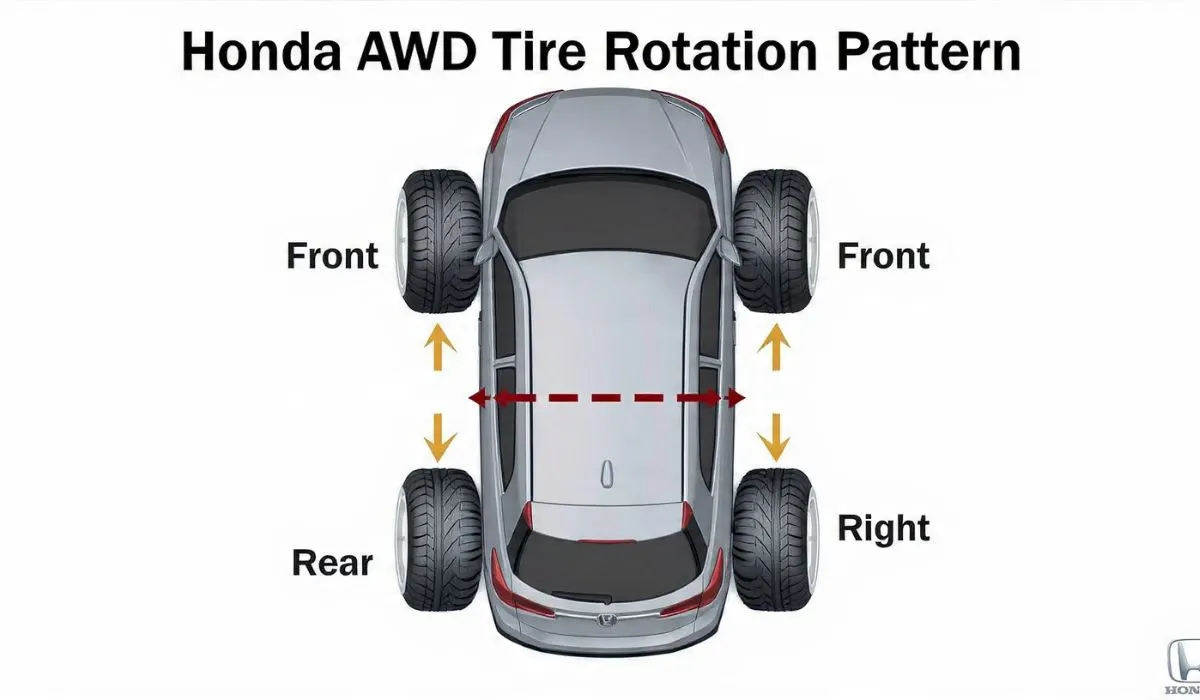
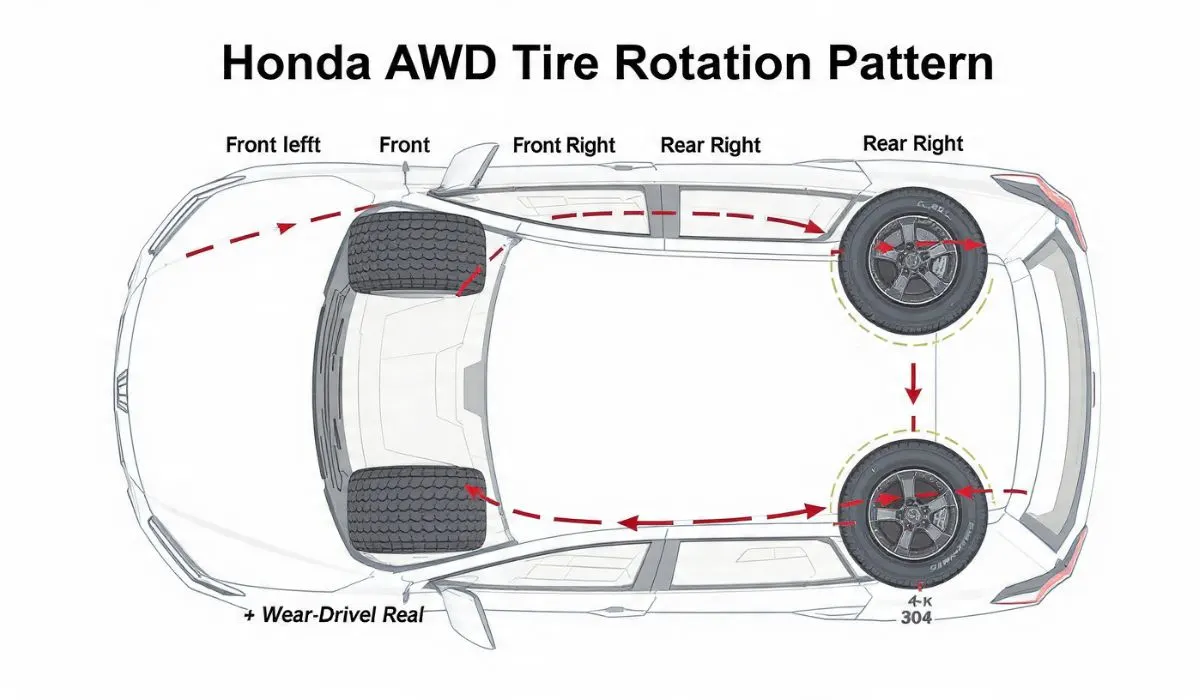
Honda generally recommends a cross-rotation pattern for AWD vehicles.
Basic AWD rotation pattern:
- Front left → Rear right
- Front right → Rear left
- Rear tires move straight to front
This pattern ensures:
- Even tread wear
- Balanced traction
- Proper AWD calibration
Directional vs Non-Directional Tires (Important Difference):
Non-directional tires
Most Honda AWD vehicles use non-directional tires.
- Can be rotated in cross pattern
- More flexibility in rotation
- Better long-term wear balance
Directional tires
If your tires have a rotation arrow:
- They must rotate front-to-back only
- No crossing allowed
- Maintains tread direction for water evacuation
Honda Recommended Tire Rotation Patterns by Drive Type:
Even though this article focuses on AWD, it helps to understand all patterns.
1. AWD vehicles (Honda CR-V, Pilot, Passport)
Recommended pattern: Cross rotation
- Front left → Rear right
- Front right → Rear left
- Rear left → Front left
- Rear right → Front right
2. Front-wheel drive (FWD)
- Front tires move straight to rear
- Rear tires cross to front
3. Rear-wheel drive (RWD)
- Rear tires move straight to front
- Front tires cross to rear
Read Next: Will Mixing Premium And Regular Gas Mess Up Your Car | Complete Expert Guide
Why AWD Requires Special Attention:
Honda AWD systems continuously adjust torque distribution. This means:
- All four tires must rotate at similar speeds
- Even small diameter differences matter
- Uneven tires confuse AWD sensors
What is “tire circumference mismatch”?
Even a small tread difference can cause:
- False wheel slip detection
- AWD engagement when not needed
- Increased drivetrain wear
Honda AWD Tire Rotation Schedule:
Recommended interval
Honda generally recommends rotating tires every:
- 8,000 to 10,000 km
- or every 6 months
Why regular rotation matters
- Prevents uneven tread wear
- Maintains AWD balance
- Improves fuel efficiency
- Extends tire lifespan
What Happens If You Don’t Rotate Tires in Honda AWD Vehicles?
1. Differential stress
AWD systems must compensate for uneven tire sizes, increasing strain.
2. Poor fuel economy
System works harder to correct traction differences.
3. Reduced traction performance
Uneven tires reduce grip consistency.
4. Expensive drivetrain repairs
In worst cases:
- Transfer case damage
- Differential wear
- Transmission stress
Expert Insight: Honda AWD System Sensitivity
Honda’s Real Time AWD system is designed for efficiency, not heavy off-road use. It reacts quickly to changes in wheel speed.
This means:
- Tire differences are detected instantly
- Even small mismatches affect system behavior
- Proper tire maintenance is essential
Signs Your Tires Are Wearing Unevenly:
Visual signs
- Front tires worn more than rear
- One side of tire more worn than other
Driving symptoms
- Slight vibration at speed
- Reduced traction in wet conditions
- Steering imbalance
Step-by-Step Honda AWD Tire Rotation Guide:
Step 1: Check tire type
- Directional or non-directional
- Same size and brand recommended
Step 2: Lift vehicle safely
Use proper jack stands for AWD vehicles.
Step 3: Apply correct rotation pattern
For non-directional AWD tires:
- Cross front tires to rear
- Move rear tires to front straight
Step 4: Check tire pressure
Adjust all tires to manufacturer PSI.
Step 5: Reset TPMS (if required)
Some Honda models require system reset after rotation.
Should You Rotate Spare Tire in Honda AWD?
Temporary spare (donut tire)
- Not recommended for rotation use
- Only for emergency driving
Full-size spare
- Can be included in rotation
- Helps maintain even wear
Tire Rotation and AWD Fuel Efficiency:
How uneven tires increase fuel use
When tires differ:
- AWD system compensates constantly
- Engine works harder
- Rolling resistance increases
Proper rotation improves efficiency slightly but consistently.
Real-Life Example:
A Honda CR-V owner ignored tire rotation for 25,000 km. The front tires wore significantly more than the rear, causing AWD system warning lights and reduced fuel efficiency.
After proper rotation and replacing one mismatched tire, the system returned to normal operation.
This shows how small maintenance habits directly impact AWD performance.
Common Mistakes Honda Owners Make:
1. Delaying tire rotation
This leads to uneven wear patterns.
2. Mixing different tire brands
Even slight size differences affect AWD balance.
3. Not checking tire pressure
Incorrect pressure accelerates uneven wear.
4. Ignoring alignment issues
Misalignment ruins rotation benefits.
Tire Rotation vs Wheel Alignment (Important Difference):
Tire rotation
- Moves tires between positions
- Balances wear
Wheel alignment
- Adjusts suspension angles
- Fixes steering geometry
Both are needed for optimal AWD performance.
Best Tires for Honda AWD Vehicles:
Recommended features
- All-season tires
- Uniform tread pattern
- OEM size compatibility
- High durability rating
When NOT to Rotate Tires:
Avoid rotation if:
- Tires have uneven damage
- Different tread depths exceed safe limits
- One tire is new and others are worn excessively
In such cases, replacement is better.
Professional vs DIY Tire Rotation:
DIY benefits
- Cost savings
- Basic maintenance skill
Professional benefits
- Proper torque tightening
- Alignment check
- Safety inspection
For AWD vehicles, professional service is often recommended.
FAQs: Honda AWD Tire Rotation Pattern
What is the correct Honda AWD tire rotation pattern?
Cross rotation: front tires to opposite rear positions, rear tires to front.
How often should I rotate tires on a Honda AWD?
Every 8,000–10,000 km or 6 months.
Can I rotate tires myself on a Honda AWD?
Yes, but proper tools and safety measures are required.
Do all Honda AWD cars use the same rotation pattern?
Most use cross rotation, but check your manual.
What happens if I don’t rotate tires?
Uneven wear, reduced AWD efficiency, and higher repair risk.
Should directional tires be cross-rotated?
No, they must rotate front-to-back only.
Does tire rotation improve fuel economy?
Yes, slightly by reducing drivetrain resistance.