
Does the Middle Number On Tires Matter | Impact on Car Performance

Yes, the middle number on a tire size matters. In a common tire size such as 205/55R16, the middle number—55—represents the tire’s aspect ratio. It tells you the sidewall height as a percentage of the tire’s width.
This number affects more than appearance. Changing the tire aspect ratio can alter the overall diameter, ride comfort, handling, steering response, speedometer accuracy, braking behavior, and clearance between the tire and vehicle components.
Understanding what the middle number means can help you choose replacement tires correctly and avoid problems caused by using an incompatible size.
What Is the Middle Number on a Tire?

Look at a tire marked:
205/55R16
The numbers and letter have specific meanings:
- 205 = tire width in millimeters
- 55 = aspect ratio
- R = radial construction
- 16 = wheel diameter in inches
Therefore, the middle number 55 means that the tire’s sidewall height is approximately 55% of its 205 mm width.
How Is the Sidewall Height Calculated?
The basic calculation is:
Sidewall height = tire width × aspect ratio
For a 205/55 tire:
205 × 0.55 = 112.75 mm
So the sidewall is approximately 112.75 mm high from the wheel rim to the tread area.
Why Does the Middle Number Matter?
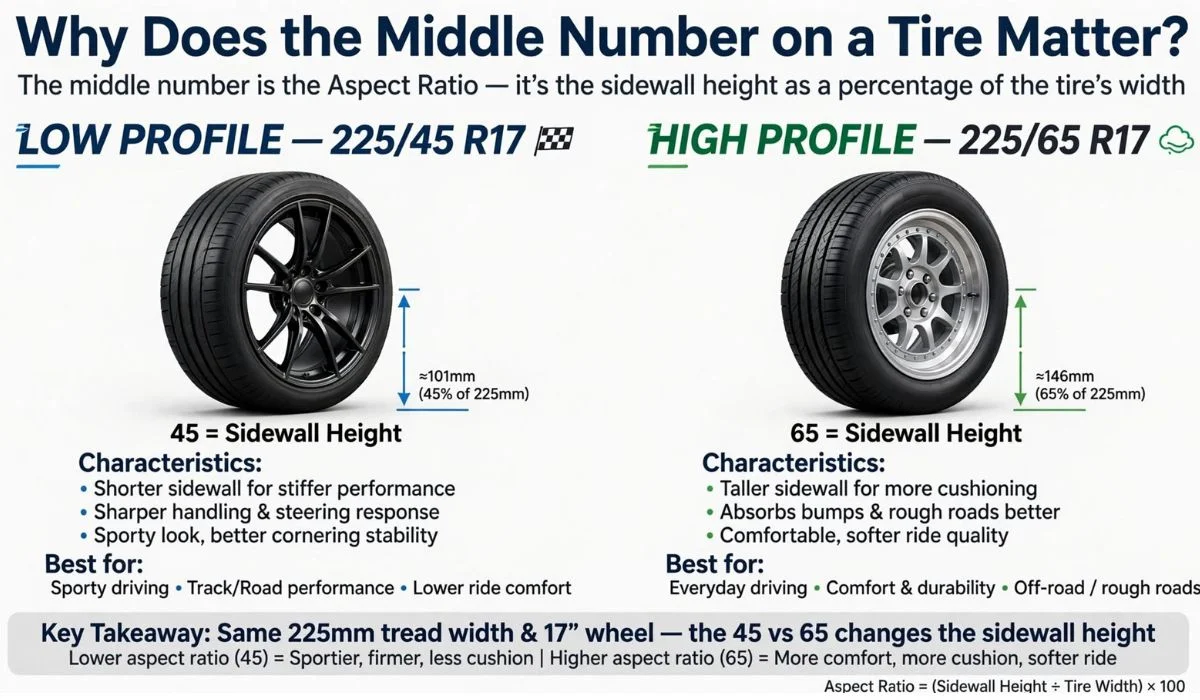
The aspect ratio influences the physical characteristics of the tire.
A lower aspect ratio generally means a shorter sidewall. A higher aspect ratio generally means a taller sidewall.
This affects how the tire flexes, absorbs bumps, responds to steering inputs, and interacts with the road.
Lower Aspect Ratio Tires
A lower number such as 40 or 45 usually means a shorter sidewall.
Potential characteristics include:
- Sharper steering response
- More direct handling
- Less sidewall flex
- Sportier appearance
- Firmer ride
- Greater vulnerability to wheel and tire damage from severe potholes
Higher Aspect Ratio Tires
A higher number such as 60, 65, or 70 generally means a taller sidewall.
Potential characteristics include:
- Softer ride
- More sidewall flex
- Better absorption of small road imperfections
- More protection against certain impacts
- Less immediate steering response
- Taller overall tire dimensions if width and wheel size remain unchanged
Is a Higher Middle Number Better?
Not necessarily.
A higher aspect ratio is not automatically better than a lower one. The appropriate number depends on the vehicle’s original specifications, wheel size, suspension design, load requirements, and intended use.
A tire with a taller sidewall may provide more comfort, while a shorter sidewall may provide more responsive handling.
Choose Based on the Vehicle
The safest starting point is the tire size recommended by the vehicle manufacturer.
Check the driver’s door-jamb label, owner’s manual, or manufacturer specifications for approved tire sizes.
Is a Lower Middle Number Better for Handling?
A lower aspect ratio can provide more responsive handling because the shorter sidewall generally flexes less during steering.
For example, changing from a 60-series tire to a 45-series tire can produce a noticeably different steering feel if the overall tire and wheel setup is appropriately matched.
However, handling depends on much more than aspect ratio.
Other Factors Affect Handling
Tire performance also depends on:
- Tire compound
- Tread design
- Tire width
- Tire pressure
- Construction
- Wheel size
- Suspension
- Alignment
- Vehicle weight
- Road conditions
Simply choosing the lowest possible aspect ratio does not guarantee better handling.
Does the Middle Number Affect Ride Comfort?

Yes.
The aspect ratio can have a noticeable effect on ride quality because the sidewall contributes to the tire’s ability to absorb impacts and road imperfections.
A taller sidewall generally provides more cushioning between the wheel and road.
Why Low-Profile Tires Can Feel Harsh
Low-profile tires have less sidewall available to flex over bumps.
On smooth roads, this may provide a precise and sporty feel. On rough roads, potholes, broken pavement, and sharp edges can feel more pronounced inside the cabin.
The exact ride quality also depends on tire construction and suspension tuning.
Does Changing the Middle Number Change Tire Height?
Yes, if the tire width remains the same.
Consider two tires:
205/55R16
and
205/60R16
Both are 205 mm wide and fit a 16-inch wheel, but their sidewall heights differ.
For 205/55:
205 × 0.55 = 112.75 mm
For 205/60:
205 × 0.60 = 123 mm
The 60-series tire therefore has a taller sidewall.
Why Overall Diameter Matters
Changing aspect ratio can change the tire’s overall diameter.
That can affect:
- Speedometer readings
- Odometer readings
- Ground clearance
- Gear ratios
- Acceleration characteristics
- Braking behavior
- ABS operation
- Traction-control systems
- Vehicle clearance
This is why changing the middle number should not be done casually.
Can You Change From 55 to 60?
Sometimes, but it depends on the vehicle.
A 55-to-60 aspect-ratio change can be acceptable on some vehicles if the resulting overall diameter remains within an appropriate range and the alternative size is approved for that vehicle.
However, simply knowing that the tire physically fits the wheel is not enough.
Check the Complete Tire Size
You must consider all of the tire-size numbers rather than changing only the middle number.
For example:
205/55R16
cannot be evaluated properly without considering the tire width, wheel diameter, load index, speed rating, and vehicle requirements.
Can You Change From 60 to 55?
Again, it may be possible on some vehicles, but it depends on the complete setup.
A smaller aspect ratio can reduce sidewall height and potentially reduce overall tire diameter.
If the resulting diameter is significantly different from the manufacturer’s specification, the vehicle’s speedometer and electronic systems may be affected.
Does the Middle Number Affect Fuel Economy?

It can, but the effect is not determined by aspect ratio alone.
A different aspect ratio may require a different wheel size, tire construction, width, or weight. These factors can influence rolling resistance and therefore fuel consumption.
Don’t Assume Lower Profile Means Better Mileage
A lower-profile tire does not automatically improve fuel economy.
A wider, heavier performance tire can sometimes increase rolling resistance or weight compared with a narrower, lighter setup.
Fuel economy depends on the complete tire and wheel combination as well as driving conditions.
Does the Middle Number Affect Speedometer Accuracy?
It can if changing the aspect ratio changes the tire’s overall diameter.
The speedometer and odometer are calibrated based on the expected rotational characteristics of the tire.
If a replacement tire is significantly larger or smaller than the original specification, the vehicle may travel a different distance per wheel revolution.
A Simple Example
Suppose the original tire has an overall diameter of approximately 24.9 inches.
If a replacement tire has a significantly different diameter, the wheel will rotate at a different rate while the vehicle is traveling at the same actual speed.
That can cause the displayed speed to differ from the actual speed.
Does Tire Aspect Ratio Affect Braking?
It can influence braking characteristics, although braking performance depends heavily on tire compound, tread, road surface, tire condition, ABS calibration, and vehicle design.
Changing tire dimensions can alter the contact characteristics and overall diameter.
Tire Grip Matters More Than the Number Alone
A premium tire with an appropriate aspect ratio can provide excellent braking performance.
A poor-quality tire with the “right” aspect ratio may perform worse.
The complete tire specification matters.
Does the Middle Number Affect Pothole Protection?
Yes.
A taller sidewall generally provides more physical cushioning between the road and wheel.
Low-profile tires have less sidewall available to absorb impact forces.
Be Careful on Rough Roads
If you frequently drive on roads with potholes, broken pavement, or rough surfaces, a tire with a taller sidewall may provide advantages in comfort and impact protection, provided it is an approved size for your vehicle.
This does not make the tire immune to damage. Severe pothole impacts can damage any tire or wheel.
Does Aspect Ratio Affect Tire Wear?
It can indirectly, but tire wear is influenced by many factors.
Incorrect tire pressure, poor alignment, aggressive driving, suspension problems, tire compound, road conditions, and rotation practices can all have substantial effects on tread life.
Keep Tire Pressure Correct
Regardless of aspect ratio, maintaining the recommended tire pressure is one of the most important maintenance practices.
Do not adjust pressure solely because you switched to a different-looking tire. Use the manufacturer’s recommended pressure unless a qualified tire professional or manufacturer specifies otherwise.
What Happens If the Middle Number Is Too Different?
A significant aspect-ratio change can produce several unwanted effects.
Possible consequences include:
- Incorrect speedometer readings
- Changed ride height
- Clearance problems
- Different steering response
- Altered ride comfort
- Changes in acceleration
- Changes in braking behavior
- Potential interference with suspension components
- Changes in electronic-system behavior
The risk depends on how much the complete tire diameter changes and whether the new size is approved for the vehicle.
What Is a Plus-Size Tire Setup?
Plus-sizing generally involves increasing wheel diameter while maintaining an overall tire diameter close to the original.
For example, moving from a smaller wheel with a taller tire to a larger wheel with a lower-profile tire can maintain a similar overall diameter.
Why People Plus-Size
Drivers may choose plus-sizing for:
- Appearance
- Handling characteristics
- Larger brake clearance
- Steering response
- Wheel selection
However, plus-sizing can also introduce a firmer ride and increased wheel-and-tire vulnerability if the sidewall becomes substantially shorter.
How Do You Know Which Middle Number to Choose?
Don’t choose the aspect ratio based solely on appearance.
Start with the tire sizes approved for your vehicle.
Check These Sources
Look at:
- Driver’s door-jamb tire label
- Owner’s manual
- Vehicle manufacturer’s specifications
- Tire information supplied by the manufacturer
- A reputable tire professional
If multiple sizes are factory-approved, compare the complete specifications rather than focusing only on the middle number.
Tire Size Example: 215/60R16 vs 215/55R16
Consider these two sizes:
215/60R16
and
215/55R16
Both are 215 mm wide and designed for a 16-inch wheel.
But their sidewall heights are different.
215 × 0.60 = 129 mm
215 × 0.55 = 118.25 mm
The 60-series tire therefore has a sidewall approximately 10.75 mm taller on each side.
That difference also changes the overall diameter.
What You May Notice
The 60-series version may provide a softer ride and more sidewall cushioning.
The 55-series version may provide a more direct steering feel.
But whether either size is suitable depends on the specific vehicle.
Does the Middle Number Matter More Than Tire Width?
Neither number should be considered in isolation.
The first number tells you tire width, while the middle number tells you aspect ratio.
Together, they determine the sidewall height.
Think of the Numbers as a Package
For example, changing from:
205/55R16
to:
225/55R16
does not simply mean you kept the same aspect ratio. Because the width increased, the actual sidewall height also increased.
That is why tire-size changes should always be evaluated as complete dimensions.
Common Mistakes When Changing Tire Size
Many tire problems begin with focusing on only one number.
Avoid these mistakes:
- Choosing a tire because it looks better
- Assuming any tire fitting the wheel is safe
- Ignoring load index
- Ignoring speed rating
- Choosing an unapproved width
- Making a large diameter change
- Using incorrect tire pressure
- Mixing incompatible tire sizes
- Assuming a lower profile is automatically better
Don’t Ignore Load and Speed Ratings
The aspect ratio is only one part of the tire specification.
A replacement tire should also meet the vehicle’s required load capacity and appropriate speed rating.
Final Takeaway:
The middle number on a tire absolutely matters. It represents the tire’s aspect ratio and indicates the sidewall height as a percentage of the tire’s width.
A lower aspect ratio generally means a shorter sidewall, which can provide a more responsive and sporty feel. A higher aspect ratio generally produces a taller sidewall that can provide additional cushioning and comfort.
But changing the middle number can also change the tire’s overall diameter. That can affect speedometer accuracy, ground clearance, handling, braking characteristics, and clearance.
The best approach is to follow the tire sizes approved by your vehicle manufacturer. If you want to change tire size, compare the complete dimensions and specifications rather than looking at the middle number alone.
FAQs | Middle Number on Tires
What does the middle number on a tire mean?
The middle number represents the tire’s aspect ratio. It indicates the sidewall height as a percentage of the tire’s width.
Is a higher tire aspect ratio better?
Not necessarily. A higher aspect ratio generally provides a taller sidewall and can improve ride comfort, while a lower ratio can provide a more responsive steering feel.
Is a lower aspect ratio better for handling?
It can provide sharper steering response because the shorter sidewall generally flexes less. However, tire compound, construction, width, pressure, suspension, and road conditions also affect handling.
Can I change a 55 tire to a 60?
Possibly, depending on the vehicle and complete tire dimensions. You should check the manufacturer’s approved sizes and make sure the resulting overall diameter and other specifications are appropriate.
Does a higher aspect ratio make a tire taller?
Yes, assuming the tire width stays the same. A higher aspect ratio creates a taller sidewall and generally increases the overall tire diameter.
Does tire aspect ratio affect fuel economy?
It can, but the effect depends on the complete tire and wheel combination. Width, weight, rolling resistance, tire compound, and wheel size can all influence fuel consumption.
Does changing the middle tire number affect the speedometer?
It can. If the aspect-ratio change significantly alters the tire’s overall diameter, the vehicle’s speedometer and odometer readings may be affected.
Does a 60-series tire ride better than a 55-series tire?
Not always, but a 60-series tire generally has a taller sidewall than a 55-series tire of the same width. That extra sidewall can provide additional cushioning and potentially a softer ride.
Are low-profile tires bad for potholes?
They can be more vulnerable to severe pothole impacts because they have less sidewall cushioning. The wheel itself can also be more exposed to impact damage.
Does the middle number affect tire width?
No. The first number represents the nominal tire width in millimeters. The middle number represents aspect ratio.
What does 205/55R16 mean?
It means the tire is approximately 205 mm wide, has a 55% aspect ratio, uses radial construction, and fits a 16-inch wheel.
Can I use a different aspect ratio on the same rim?
Some different aspect ratios may physically fit the same wheel diameter, but physical fit does not automatically mean the tire is suitable for the vehicle. Overall diameter, clearance, load rating, speed rating, and manufacturer approval must be considered.
Which is more comfortable, 45 or 55 tires?
Assuming similar width and construction, a 55-series tire has a taller sidewall than a 45-series tire and may provide a more cushioned ride.
Does tire aspect ratio affect braking distance?
It can influence handling and tire characteristics, but braking distance depends on many factors, including tire compound, tread, road surface, vehicle weight, brake system, temperature, and tire condition.
Should all four tires have the same aspect ratio?
For most conventional vehicles, the tires on the same axle should match the manufacturer’s specifications, and many vehicles require the same size on all four corners. Some vehicles are designed with different front and rear sizes, so always follow the vehicle manufacturer’s specifications.
What should I check before changing tire size?
Check the manufacturer’s approved tire sizes, tire width, aspect ratio, wheel diameter, load index, speed rating, overall diameter, clearance, and recommended tire pressure.