Can You Change Tires At Home | A Complete Step-by-Step Guide, Essential Tools, Safety Tips, and Best Practices

Yes, you can change tires at home, but the answer depends on what you mean by “change tires.” If you mean replacing a flat tire with a spare or swapping a complete wheel-and-tire assembly, many drivers can do it with basic tools. If you mean removing a tire from a wheel rim and installing a new tire, the job is considerably more difficult and requires specialized equipment.
Changing a complete wheel is generally a manageable DIY task when you have the correct jack, jack stands, wheel chocks, lug wrench, and vehicle-specific instructions. Mounting a tire onto a rim is different because the tire bead must be broken, removed, installed, and safely inflated.
Before deciding to change tires at home, understand which job you are performing, what equipment it requires, and where the safety risks are.
What Does “Changing Tires at Home” Actually Mean?
The phrase can describe several different jobs. Knowing the difference helps you choose the right tools and avoid attempting a procedure that requires professional equipment.
Swapping a complete wheel
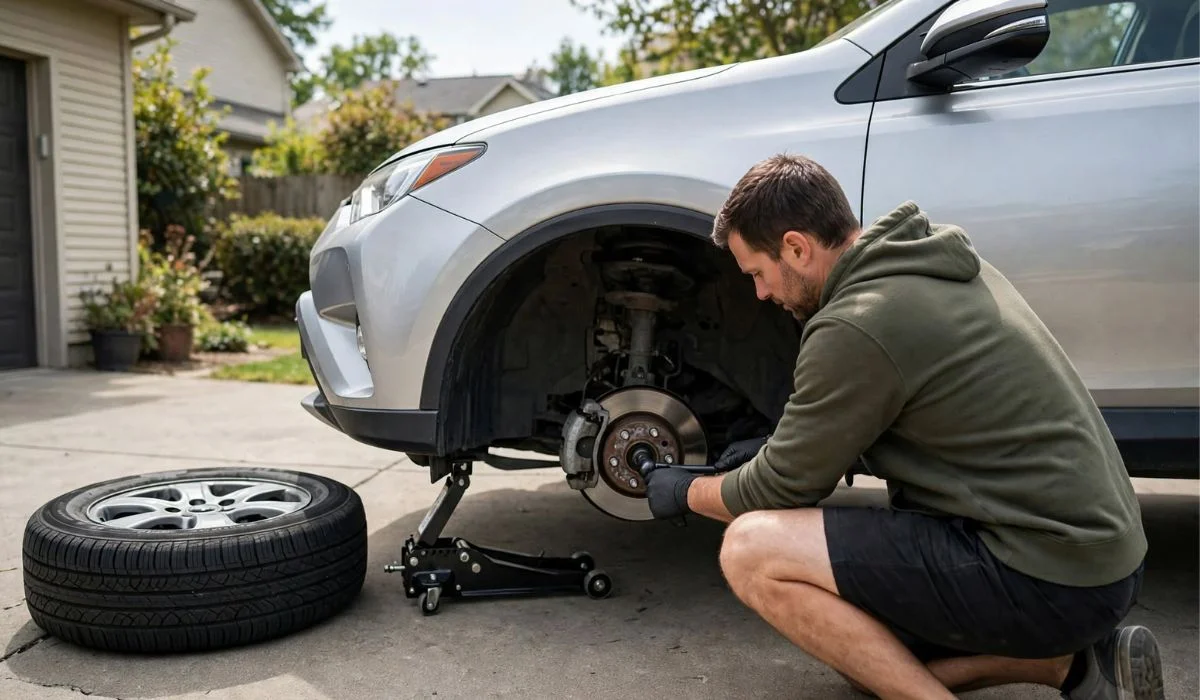
This means removing a complete wheel and tire from the vehicle and replacing it with another complete wheel and tire.
For example, you might:
- Install a spare tire
- Change from summer to winter wheels
- Replace a damaged wheel
- Rotate your tires
- Install a second set of wheels
This is usually the easiest type of tire change to perform at home.
Replacing the tire on the rim
This involves removing the rubber tire from the metal wheel and installing a new tire onto that same wheel.
The process includes:
- Completely deflating the tire
- Breaking the bead
- Removing the old tire
- Inspecting the wheel
- Mounting the new tire
- Seating the beads
- Inflating the tire
- Checking for leaks
- Balancing the assembly
This job is much more demanding and can be dangerous without appropriate equipment.
Can You Change Tires at Home With Basic Tools?
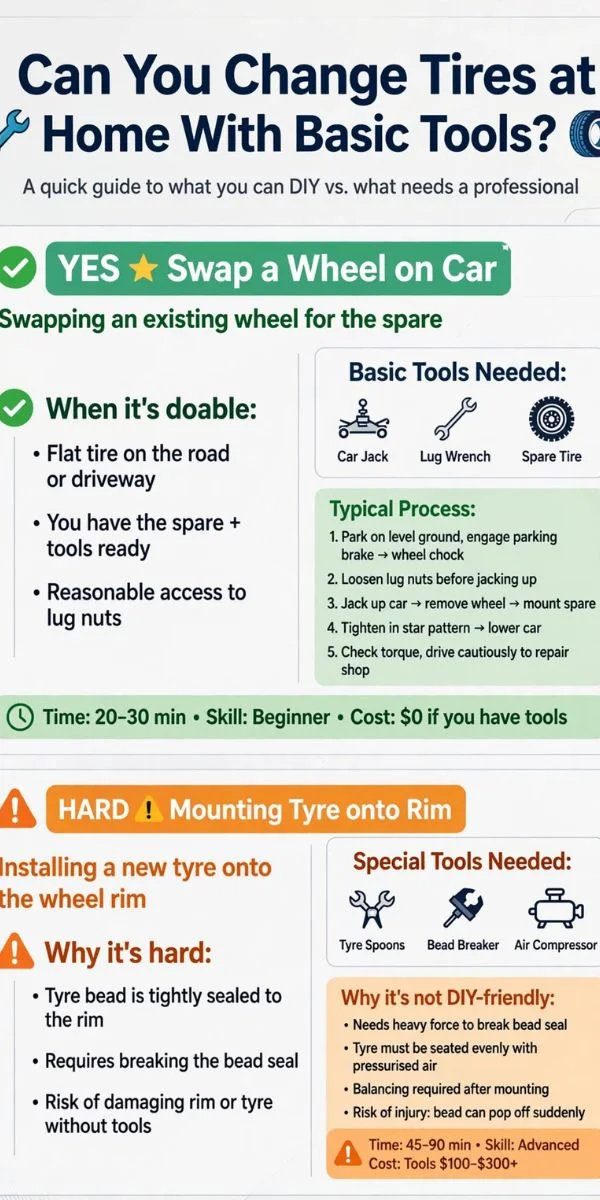
You can change a complete wheel at home with relatively basic equipment, provided you follow the vehicle manufacturer’s instructions.
A typical wheel swap may require:
- Lug wrench
- Correct jack
- Jack stands
- Wheel chocks
- Torque wrench
- Gloves
- Work light
- Tire pressure gauge
However, a floor jack should not be treated as a substitute for jack stands when the vehicle needs to remain elevated while you work underneath or around it.
What basic tools are good for
Basic tools are generally suitable for jobs such as:
- Installing a spare
- Rotating complete wheel assemblies
- Removing and installing wheels
- Checking tire pressure
- Inspecting tires
- Cleaning wheel mounting surfaces
They are not sufficient for safely removing and mounting most modern passenger-car tires onto rims.
Can You Mount a New Tire on a Wheel at Home?
Technically, yes, but it requires considerably more skill and equipment.
A proper setup may include:
- Tire changer
- Bead breaker
- Mounting tools
- Approved tire lubricant
- Air compressor
- Accurate pressure gauge
- Inflation equipment
- Appropriate safety equipment
- Wheel balancer
The most hazardous stage is often inflating the newly mounted tire and seating the bead. A tire and wheel assembly stores significant energy when pressurized, so incorrect mounting can result in serious injury.
For this reason, tire manufacturers and industry organizations recommend proper equipment and procedures for tire mounting and inflation.
Why tire mounting is different
A wheel swap mainly involves mechanical fasteners.
Tire mounting involves manipulating a flexible but heavily reinforced rubber structure around a rigid metal rim and then pressurizing the completed assembly.
That combination makes mistakes more consequential.
What You Need to Change a Complete Tire at Home
If your goal is simply to replace a wheel-and-tire assembly, prepare everything before lifting the vehicle.
Essential equipment
A useful home tire-changing setup includes:
| Tool | Purpose |
|---|---|
| Wheel chocks | Help prevent vehicle movement |
| Vehicle-approved jack | Raises the vehicle |
| Jack stands | Provide stable support when required |
| Lug wrench | Removes and installs wheel fasteners |
| Torque wrench | Tightens fasteners to specification |
| Tire-pressure gauge | Checks inflation pressure |
| Gloves | Protect hands |
| Work light | Improves visibility |
Your vehicle may require additional tools depending on its design.
How to Change a Complete Tire at Home
If you are replacing a complete wheel-and-tire assembly, the process is relatively straightforward when performed correctly.
Park on a safe surface
Choose a firm, level surface.
Avoid working on:
- Soft soil
- Loose gravel
- Steep slopes
- Unstable shoulders
- Areas with heavy traffic
Put the vehicle in Park if it has an automatic transmission or in the appropriate gear if it has a manual transmission. Apply the parking brake.
Place wheel chocks where appropriate to help prevent movement.
Loosen the wheel fasteners
Before lifting the vehicle, slightly loosen the lug nuts or wheel bolts.
Do not completely remove them while the wheel is still carrying the vehicle’s weight.
A lug wrench or breaker bar may be useful if the fasteners are tight.
Lift the vehicle correctly
Use only the manufacturer’s designated jacking point.
Do not place the jack under an arbitrary suspension component, floor panel, or body section simply because it appears strong enough.
Once raised, use appropriate support equipment whenever the vehicle must remain elevated for the job.
Remove the wheel
Remove the loosened wheel fasteners and carefully pull the wheel away from the hub.
Some wheels may stick to the hub because of corrosion.
Do not position your body beneath an unsupported vehicle while removing a wheel.
Install the replacement wheel
Place the replacement wheel onto the hub.
Install the wheel fasteners by hand initially to reduce the risk of cross-threading.
Tighten them in the pattern specified by the vehicle manufacturer.
Read Next: How To Change A Tyre On A Wheel
Lower and torque the wheel
Lower the vehicle enough to prevent the wheel from rotating while final tightening is performed, if appropriate for the vehicle and manufacturer’s procedure.
Use a torque wrench and the manufacturer’s specified torque.
Do not guess the torque value.
When Should You Use a Spare Tire?
A spare tire is intended to get you back on the road safely, but spare types have different limitations.
Full-size spare
A full-size spare may be similar to the other tires and can sometimes be used normally, depending on the vehicle and tire specifications.
However, confirm the vehicle manufacturer’s instructions.
Temporary spare
A compact temporary spare, often called a “donut,” usually has specific restrictions.
These may include:
- Lower maximum speed
- Limited driving distance
- Different handling characteristics
- Different traction
- Different recommended pressure
Always follow the instructions printed on the spare and in the vehicle owner’s manual.
Can You Change Tires Without a Tire Machine?
If you mean swapping a complete wheel, yes.
If you mean removing a tire from its rim, it is possible to perform some manual mounting procedures with tire levers and other equipment, but that does not mean it is a good choice for every DIYer.
Modern passenger tires can have stiff sidewalls and tight beads.
Trying to force them off or onto a rim can cause:
- Damaged tire beads
- Scratched wheels
- Bent rims
- Pinched components
- Personal injury
The inflation stage adds another significant hazard.
Manual tire changing is not automatically safer
Using fewer tools does not necessarily make the job safer.
A professional tire machine is designed to control the tire and rim during mounting and demounting while reducing the amount of force required.
How Much Does It Cost to Change Tires at Home?
The cost depends heavily on which type of tire change you want to perform.
If you are swapping complete wheel assemblies, you may only need basic equipment such as a jack, stands, torque wrench, and tire-pressure gauge.
If you want to mount tires onto rims yourself, the equipment investment can become much larger.
You may need:
- Tire changer
- Bead breaker
- Compressor
- Mounting tools
- Inflation equipment
- Wheel balancer
- Safety equipment
For someone changing tires only once or twice a year, professional installation may be more economical.
For someone who regularly changes multiple sets of tires, investing in equipment may make more sense.
Do You Need to Balance Tires After Changing Them?
If you are simply moving a complete wheel from one position to another during a tire rotation, you do not automatically need to rebalance the wheel.
If you install a new tire onto a rim, however, balancing is normally recommended.
Why wheel balancing matters
The tire and wheel assembly does not always have perfectly uniform weight distribution.
An imbalance can cause:
- Steering-wheel vibration
- Seat or floor vibration
- Uneven tire wear
- Reduced driving comfort
A professional wheel-balancing machine identifies the imbalance and determines where balancing weights should be installed.
Do You Need an Alignment After Changing Tires?
Not necessarily.
Replacing or swapping tires does not automatically mean that the wheel alignment has changed.
However, an alignment check may be worthwhile if you notice:
- Vehicle pulling to one side
- Steering wheel off-center
- Uneven tire wear
- Vehicle instability
- Previous suspension damage
- A strong impact with a pothole or curb
Tire replacement and wheel alignment are separate services.
How to Know If Your Tires Are Safe to Change Yourself
Before starting, ask yourself a few practical questions.
Consider your equipment
Do you have the correct tools for the specific job?
If you only have a basic car jack and lug wrench, you may be equipped for a spare-tire change but not for tire mounting.
Consider your experience
Have you safely lifted a vehicle before?
Do you know the manufacturer’s jack points?
Do you have experience using a torque wrench?
Do you understand tire sidewall markings?
If the answer to several of these questions is no, professional assistance may be the better option.
Consider the condition of the tire and wheel
DIY work becomes less appropriate when you find:
- Cracked wheels
- Severely corroded rims
- Damaged beads
- Sidewall damage
- Bent wheels
- TPMS components requiring service
- Unusual tire construction
A professional can inspect these problems before completing the installation.
Common Mistakes People Make When Changing Tires at Home
Using the wrong jacking point
A vehicle’s body is not designed for the jack to be placed anywhere you want.
Always use the manufacturer’s designated lifting points.
Relying on the jack as permanent support
A jack is designed to lift the vehicle, not necessarily to serve as long-term support while you work.
Use properly rated support equipment according to the vehicle and equipment instructions.
Guessing lug nut torque
Too little torque can allow fasteners to loosen.
Too much torque can damage fasteners, studs, wheels, or brake components.
Use the manufacturer’s specified torque.
Installing the wrong tire
Always verify:
- Tire size
- Load index
- Speed rating
- Construction
- Seasonal requirements
- Directional markings
Forgetting tire pressure
After installing a wheel, check the tire pressure when the tires are cold and set it according to the vehicle manufacturer’s recommended pressure.
Ignoring vibration after installation
A new vibration should not simply be ignored.
It could indicate:
- Wheel imbalance
- Incorrect wheel installation
- Tire damage
- Wheel damage
- Improper seating
- Other mechanical problems
Is It Better to Change Tires at Home or at a Shop?
There is no single answer for every driver.
A home tire change can be convenient when you are swapping complete wheel assemblies and already have the correct equipment.
A professional shop becomes more attractive when you need tire mounting, balancing, TPMS service, or inspection of damaged components.
| Situation | Home DIY | Professional shop |
|---|---|---|
| Install spare tire | Suitable with proper tools | Optional |
| Rotate complete wheels | Often suitable | Optional |
| Swap seasonal wheel sets | Often suitable | Optional |
| Mount tire onto rim | Advanced | Recommended |
| Balance new tire | Usually requires equipment | Recommended |
| Repair damaged wheel | Not ideal | Recommended |
| Service complex TPMS | Depends on vehicle | Often preferable |
| Damaged tire bead | Not recommended | Recommended |
How to Make a Home Tire Change Safer
Preparation is more important than speed.
Keep the owner’s manual nearby and confirm:
- Jacking points
- Wheel-fastener torque
- Spare-tire restrictions
- Tire-pressure specifications
- Wheel installation instructions
Work during daylight or use strong lighting.
Keep children and pets away from the work area.
Never rush because you are trying to get back on the road quickly.
If something does not look or feel right, stop and investigate it rather than forcing the job.
Final Answer: Can You Change Tires at Home?
So, can you change tires at home? Yes—but the type of tire change matters.
Swapping a complete wheel-and-tire assembly is a realistic DIY job for many vehicle owners who have the correct tools and understand safe lifting and wheel installation.
Removing a tire from a rim and installing a new one is a different level of work. It requires specialized equipment, careful bead handling, controlled inflation, and proper balancing. For occasional tire replacement, professional installation is often the safer and more practical choice.
The best DIY approach is to know the limits of your equipment and experience. Saving a little money is not worth taking unnecessary risks with a pressurized tire or an improperly supported vehicle.
FAQs
Can I change all four tires at home?
You can swap four complete wheel-and-tire assemblies at home if you have suitable equipment and a safe working area. If you mean mounting four new tires onto rims, specialized tire-changing and balancing equipment is recommended.
Is changing a tire at home difficult?
Changing a complete wheel is usually much easier than mounting a tire onto a rim. The difficulty increases considerably when bead breaking, tire mounting, inflation, and balancing are involved.
Can I change a tire with just a jack and lug wrench?
A jack and lug wrench may be enough for an emergency spare-tire change when used according to the vehicle manufacturer’s instructions. They are not enough for safely mounting a new tire onto a wheel.
Do I need jack stands to change a tire?
For a brief wheel change using the vehicle’s designated jack, follow the manufacturer’s instructions. If the vehicle needs to remain raised while you work, appropriate support equipment is essential. Never place yourself under a vehicle supported only by an ordinary jack.
Can I put a new tire on an old rim?
Yes, if the rim is compatible and in suitable condition. The wheel should be inspected for cracks, bends, severe corrosion, and other damage before mounting the new tire.
Can I change tires without removing the wheels from the car?
No, not for replacing the tire itself. A tire must be removed from the wheel before a new tire can be mounted. A complete wheel-and-tire assembly can, however, be swapped while the vehicle is stationary.
Do new tires need balancing?
Generally, yes. When a new tire is mounted onto a wheel, the completed assembly should normally be balanced to reduce vibration and promote even wear.
Do I need an alignment when I install new tires?
Not automatically. Tire installation itself does not necessarily change alignment. An alignment check is more appropriate when there are symptoms such as pulling, an off-center steering wheel, or uneven tire wear.
Can I change a tire at home without an air compressor?
For swapping a complete inflated wheel, an air compressor is not necessary, although a pressure gauge is useful. For mounting a tire onto a rim, suitable inflation equipment is required.
What is the biggest danger when changing tires at home?
For a complete wheel swap, vehicle instability while it is lifted is a major concern. For mounting a tire onto a rim, improper bead seating and inflation can create a serious pressurized-tire hazard.
Is it cheaper to change tires yourself?
It can be cheaper if you are swapping complete wheel assemblies and already own the necessary equipment. For mounting new tires onto rims, the cost of buying tire-changing and balancing equipment can outweigh the labour savings for occasional jobs.
When should I take my tire to a professional?
Use a professional when the tire or wheel is damaged, the bead will not seat correctly, you lack suitable mounting equipment, you need wheel balancing, or you are unsure about the correct installation procedure.