

Tire Rotation Pattern Rear Wheel Drive | Complete Guide to Proper Tire Rotation, Direction, and Best Practices

Knowing the correct tire rotation pattern for rear wheel drive vehicles can help promote more even tread wear, extend tire life, and maintain predictable handling. Rear-wheel-drive cars send engine power to the rear wheels, so the rear tires typically experience greater acceleration-related stress while the front tires handle steering and much of the braking.
Because tires can wear differently depending on their position, rotating them at the appropriate intervals can help distribute that wear more evenly. However, the correct pattern depends on whether your tires are non-directional, directional, staggered, or have different front and rear specifications.
What Is the Best Tire Rotation Pattern for Rear Wheel Drive?
For a typical rear-wheel-drive vehicle with four matching, non-directional tires, the recommended pattern is usually the rearward cross pattern.
In this pattern:
- Left rear → left front
- Right rear → right front
- Left front → right rear
- Right front → left rear
In simple terms, the rear tires move straight forward, while the front tires move diagonally to the opposite rear positions.
This is commonly known as the rearward cross pattern.
Rearward Cross Example
Imagine your tires are positioned like this:
Front:
Left Front | Right Front
Rear:
Left Rear | Right Rear
After rotation:
Front:
Left Rear | Right Rear
Rear:
Right Front | Left Front
The exact permitted pattern should always be confirmed against your vehicle and tire manufacturer’s recommendations.
Why Is Tire Rotation Important on Rear-Wheel-Drive Cars?

Rear-wheel-drive vehicles can place additional workload on the rear tires because they transmit engine torque to the road.
The front tires also experience significant wear because they steer the vehicle and contribute heavily during braking.
Without rotation, one axle may wear considerably faster than the other.
Different Wheels Perform Different Jobs
On a rear-wheel-drive car:
- Rear tires transmit engine power.
- Front tires handle steering.
- All four tires contribute to braking.
- Front tires may experience additional cornering forces.
Regular rotation can help distribute these different wear patterns across the set.
How Does the Rearward Cross Pattern Work?

The rearward cross pattern is designed for many rear-wheel-drive vehicles with non-directional tires.
The rear tires move forward without crossing.
The front tires cross to the opposite rear positions.
Left Rear to Left Front
The left rear tire moves directly to the left front position.
This keeps the tire on the same side of the vehicle.
Right Rear to Right Front
The right rear tire moves directly to the right front position.
Like the left rear tire, it moves straight forward.
Front Tires Cross to the Rear
The left front tire moves to the right rear.
The right front tire moves to the left rear.
This cross movement changes the tire’s side of the vehicle.
Can You Rotate Directional Tires on a Rear-Wheel-Drive Car?
Yes, but the pattern is different.
Directional tires are designed to rotate in a specific direction. Their tread pattern is engineered to work properly when traveling in that direction.
You generally should not move a directional tire from one side of the vehicle to the other unless the tire is remounted on the wheel so its directional orientation remains correct.
Directional Tire Rotation Pattern
For a vehicle with four same-size directional tires, the typical rotation is:
- Left front ↔ left rear
- Right front ↔ right rear
In other words, the tires move front to rear on the same side.
This keeps their rotational direction unchanged.
What About Staggered Rear-Wheel-Drive Tires?
Some performance and sports cars use staggered tires.
A staggered setup means the front and rear tires have different widths or sizes.
For example:
- Front: 225/45R18
- Rear: 255/40R18
In many staggered setups, the front and rear tires cannot simply be moved between axles.
Why Staggered Tires Are Different
A larger rear tire may be specifically selected to provide traction for the driven rear axle.
If the front and rear tire sizes are different, you must follow the manufacturer’s specific rotation instructions.
Some staggered setups allow side-to-side rotation if the tires are non-directional and the manufacturer permits it. Others do not allow conventional rotation at all.
What If the Tires Are the Same Size but Directional?
A same-size directional setup can still be rotated, but only while maintaining the correct rolling direction.
The usual approach is moving each tire from front to rear on the same side.
Check the Sidewall Arrows
Directional tires normally have an arrow or marking indicating the intended direction of rotation.
After rotating them, verify that every tire’s directional arrow still points in the correct direction.
Never assume that a tire is non-directional simply because the size is identical front and rear.
Read Next: Does the Middle Number On Tires Matter | Impact on Car Performance
How Often Should You Rotate Rear-Wheel-Drive Tires?
Many manufacturers recommend tire rotation at approximately 5,000–8,000 miles, or roughly 8,000–13,000 kilometers, although the correct interval varies by vehicle and tire.
Some manufacturers recommend rotation at every scheduled maintenance service.
Follow Your Vehicle’s Manual
The owner’s manual should take priority over a generic interval.
The ideal schedule can depend on:
- Vehicle type
- Tire design
- Driving conditions
- Tire compound
- Wheel alignment
- Suspension condition
- Driving style
- Front/rear weight distribution
If your manufacturer specifies a different interval, follow that recommendation.
Why Rear Tires Can Wear Faster on RWD Vehicles
The rear tires of a rear-wheel-drive vehicle receive power from the engine.
When accelerating, the driven tires must transmit torque through the tire contact patches to the road.
Aggressive acceleration can increase rear-tire wear considerably.
Driving Style Makes a Difference
Hard acceleration, frequent spirited driving, towing, and driving on rough or hilly roads can increase tire wear.
A calm driving style generally places less stress on the tires.
Can Tire Rotation Improve Tire Life?
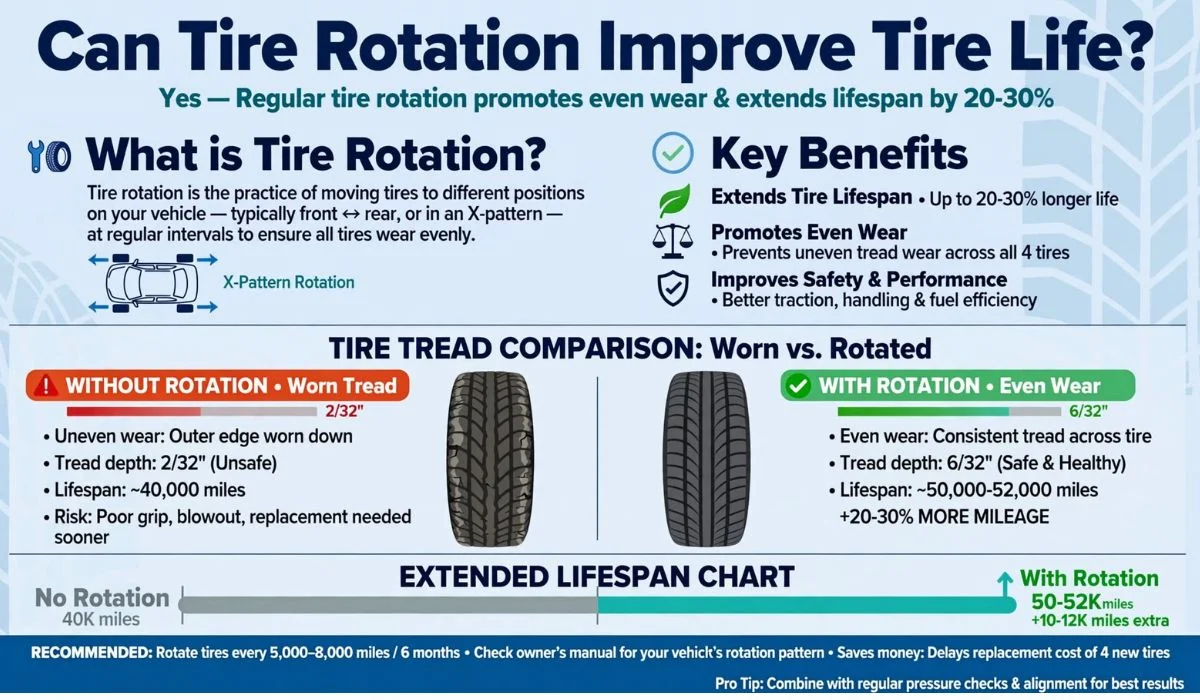
Regular rotation can help distribute wear across the four tires.
Instead of allowing the rear tires to wear significantly faster than the front tires, rotation gives each tire an opportunity to operate in different positions.
Rotation Does Not Fix Existing Problems
Tire rotation cannot correct:
- Bad wheel alignment
- Incorrect tire pressure
- Worn suspension components
- Damaged tires
- Bent wheels
- Brake problems
If a tire is wearing abnormally, identify the underlying cause rather than relying solely on rotation.
What Does Uneven Tire Wear Tell You?
The tread pattern can provide useful clues about vehicle condition.
Different wear patterns can point toward different problems.
Center Tread Wear
Excessive wear in the center of the tread may be associated with overinflation.
Check the recommended cold tire pressure rather than simply lowering pressure based on appearance.
Both Shoulder Areas Wearing
Wear on both outer shoulders can be associated with underinflation.
However, tire pressure should always be checked with a reliable gauge.
One Edge Wearing More Than the Other
Uneven wear on one side may indicate an alignment or suspension issue.
A professional inspection can determine the actual cause.
Cupping or Scalloped Wear
Irregular dips or scalloped tread wear can sometimes be associated with suspension, wheel balance, or tire-related problems.
Don’t simply rotate the tires and ignore persistent irregular wear.
How to Rotate Rear-Wheel-Drive Tires Correctly:

Before rotating your tires, verify that the tires are actually eligible for the intended pattern.
Check the tire sidewalls and vehicle documentation.
Step 1: Identify the Tire Type
Determine whether your tires are:
- Non-directional
- Directional
- Staggered
- Same-size
- Different front and rear sizes
This determines which rotation patterns are possible.
Step 2: Check the Manufacturer’s Recommendation
Look at the owner’s manual and tire manufacturer’s guidance.
Some vehicles have special requirements because of drivetrain configuration, tire size, or electronic stability systems.
Step 3: Inspect the Tires
Check tread depth, cracks, bulges, punctures, and unusual wear.
A tire with structural damage should not simply be moved to another position.
Step 4: Check Tire Pressure
After rotation, adjust each tire to the manufacturer’s recommended pressure for its new position if the vehicle specifies different front and rear pressures.
Step 5: Tighten the Wheel Fasteners Correctly
If you are performing the rotation yourself, use the vehicle manufacturer’s specified wheel-fastener torque.
Do not rely on simply tightening the lug nuts as hard as possible.
Should You Rotate Tires on an AWD Vehicle the Same Way?
Not necessarily.
All-wheel-drive vehicles can have different tire-rotation requirements because all four wheels can receive engine power.
Tire circumference differences can also be important for certain AWD systems.
Don’t Apply the RWD Pattern Automatically
A rotation pattern that works for a conventional rear-wheel-drive vehicle may not be correct for an AWD vehicle.
Always check the vehicle manufacturer’s instructions.
Does Tire Rotation Affect Wheel Alignment?
No. Rotating tires does not change the vehicle’s wheel alignment by itself.
However, tire rotation can reveal an alignment problem because a tire may show uneven wear after being moved.
Alignment and Rotation Work Together
If your tires repeatedly develop uneven wear after rotation, have the alignment and suspension inspected.
A proper rotation schedule cannot compensate for incorrect alignment angles.
What Happens If You Never Rotate RWD Tires?
The driven rear tires may wear faster than the front tires, especially with aggressive acceleration or heavy use.
Eventually, you may have significantly different tread depths between the front and rear axles.
Why Uneven Tread Depth Matters
Different tread depths can affect traction balance and handling.
Replacing only two tires may also require careful consideration of where the new tires should be installed. In many conventional vehicles, tire professionals recommend placing the tires with greater remaining tread on the rear axle, but the correct approach depends on the vehicle, tire type, and manufacturer’s guidance.
Should New Tires Go on the Front or Rear?
For many vehicles, when replacing only two tires, the newer tires are commonly recommended for the rear axle, including many rear-wheel-drive vehicles.
The reasoning is that greater rear traction can help reduce the risk of oversteer or loss of rear stability on wet roads.
Check the Tire Shop’s Recommendation
Tire installation should take into account:
- Drivetrain
- Tire size
- Existing tread depth
- Tire condition
- Vehicle manufacturer’s recommendations
Don’t decide solely based on whether the car is front-wheel drive or rear-wheel drive.
Does Tire Rotation Improve Fuel Economy?
Tire rotation itself does not directly make the engine consume less fuel.
However, keeping tires properly maintained can help preserve even tread wear and predictable rolling characteristics.
Tire Pressure Matters More
For fuel economy, maintaining the manufacturer’s recommended tire pressure is generally more important than the rotation pattern itself.
Underinflated tires can increase rolling resistance and make the engine work harder.
Can You Rotate Tires at Home?
Yes, if you have the appropriate equipment, experience, and a safe working area.
However, lifting a vehicle incorrectly can be extremely dangerous.
Use Proper Safety Equipment
Never rely solely on a jack to support a vehicle while working underneath or around it.
Use appropriately rated jack stands and follow safe lifting points specified by the vehicle manufacturer.
If you are not confident about safely lifting the vehicle, have the tires rotated by a qualified tire shop or mechanic.
Rear-Wheel-Drive Tire Rotation Pattern at a Glance
For four matching, non-directional tires, the common rearward-cross pattern is:
Left Rear → Left Front
Right Rear → Right Front
Left Front → Right Rear
Right Front → Left Rear
For four same-size directional tires:
Left Front ↔ Left Rear
Right Front ↔ Right Rear
For staggered tires, the appropriate pattern depends on the vehicle and tire specifications.
Final Takeaway
The most common tire rotation pattern for rear-wheel-drive vehicles with four matching, non-directional tires is the rearward cross pattern. The rear tires move straight to the front, while the front tires move diagonally to the opposite rear positions.
However, this is not a universal rule. Directional tires generally need to remain on the same side, while staggered tire setups may have limited or no rotation options.
Before rotating your tires, check the owner’s manual, tire sidewalls, and manufacturer’s recommendations. Regular rotation, correct tire pressure, proper alignment, and timely inspection can help your tires wear more evenly and maintain safe handling.
FAQs About Tire Rotation Pattern for Rear-Wheel Drive
What is the best tire rotation pattern for rear-wheel drive?
For a typical rear-wheel-drive vehicle with four matching non-directional tires, the rearward cross pattern is commonly used. Rear tires move straight forward, while front tires cross to the opposite rear positions.
Do rear-wheel-drive cars need tire rotation?
Yes. Rotation can help distribute the different wear experienced by the front and rear tires and may help extend the useful life of the tire set.
How often should I rotate tires on a RWD car?
Many vehicles recommend rotation around every 5,000–8,000 miles, but the correct interval should come from the vehicle manufacturer or tire manufacturer.
Do RWD tires rotate front to back?
They can, depending on the tire type. With non-directional tires, a rearward-cross pattern is commonly used. Directional tires generally move front to rear on the same side.
Can directional tires be rotated on a rear-wheel-drive car?
Yes, but they generally need to remain on the same side so their directional tread continues rotating correctly.
Can staggered tires be rotated?
Sometimes, but many staggered setups have limited rotation options. Check the manufacturer’s instructions before moving them.
Should rear tires cross during rotation?
In the common rearward-cross pattern, the front tires cross to the rear, while the rear tires move straight forward. The exact pattern depends on tire construction and vehicle specifications.
Does tire rotation change tire pressure?
The rotation itself does not change the pressure, but the recommended pressure may differ between front and rear positions on some vehicles. Check and adjust pressure after moving the tires.
Does rotating tires improve handling?
Proper rotation can help maintain more even tread wear, which may contribute to predictable handling. It cannot compensate for worn suspension parts, incorrect alignment, damaged tires, or improper inflation.
Why do rear tires wear faster on RWD cars?
The rear tires transmit engine power to the road. Acceleration, especially aggressive acceleration, can place additional stress on the rear tires and increase their wear rate.
Can I rotate my tires myself?
Yes, if you have the proper equipment and know how to safely lift and support the vehicle. If you are uncertain, using a professional tire service is safer.
Does tire rotation improve gas mileage?
Rotation does not directly reduce fuel consumption. However, proper tire maintenance, including correct inflation and alignment, can help minimize unnecessary rolling resistance.
Should I rotate tires if one is wearing unevenly?
You should determine why the tire is wearing unevenly first. Alignment, suspension, inflation, wheel balance, or tire damage may be responsible.
Is the tire rotation pattern the same for FWD and RWD?
Not always. For four matching non-directional tires, FWD vehicles commonly use a forward-cross pattern, while RWD vehicles commonly use a rearward-cross pattern. Directional and staggered tires require different considerations.
What is the rearward cross tire rotation pattern?
It is a rotation method where the rear tires move straight forward and the front tires move diagonally to the opposite rear positions.
Should new tires be installed on the rear of a RWD car?
When replacing only two tires, placing the tires with greater remaining tread on the rear is commonly recommended for many vehicles because maintaining rear traction can improve stability, particularly on wet roads. Always follow the vehicle and tire manufacturer’s recommendations.